Bronnen die "bewijzen" dat Lisa del Giocondo de Mona Lisa van Leonardo is
Bronnen die “bewijzen” dat Lisa del Giocondo de Mona Lisa van Leonardo is.
De meeste kunsthistorici zijn er nog steeds van overtuigd dat Leonardo da Vinci op het portret van de Mona Lisa de vrouw van de zijdekoopman Francesco del Giocondo, heeft afgebeeld. Bij de identificatie van Mona Lisa als Lisa del Giocondo baseert men zich hoofdzakelijk op volgende bronnen:
1. De Vespucci-nota:
In een aantekening van oktober 1503 in een tekst van Cicero (Epistulae ad Familiares, nu in de Universiteitsbibliotheek van Heidelberg en ontdekt in 2005) schrijft Agostino Vespucci (notaris en ambtenaar van de Florentijnse kanselarij)
“Appelles Pictor. Ita Leonardus Vincius facit in omnibus suis picturis ut enim caput Lise del Giocondo et Anne matris virginis..”
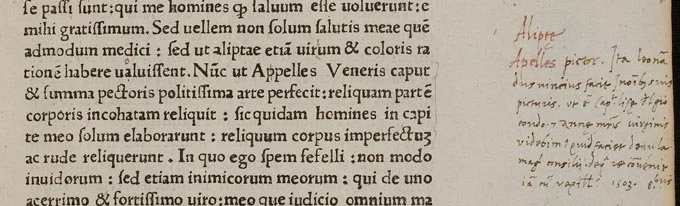
Fig.1 Vespucci-nota (Uni.Heidelberg)
Hij getuigt dat Leonardo op dat moment werkte aan een portret met het hoofd van Lisa del Giocondo en van Sint-Anna (zie fig.1). Hij vergelijkt Leonardo’s schilderstijl met die van de Griek Apelles die ook veel werken onvoltooid liet (1).
2. Het dagboek van Antonio de Beatis:
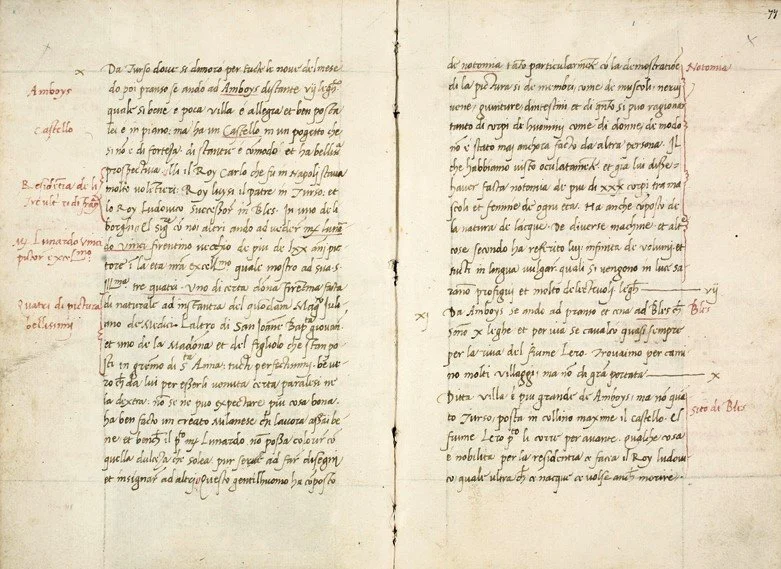
In zijn dagboek (zie fig.2) schrijft Antonio de Beatis (reisgezel en secretaris van kardinaal Luigi van Aragon) dat zij op 10 oktober 1517 in Leonardo’s woning van Clos-Lucé 3 schilderijen van de meester te zien kregen:
"Uno di certa donna fiorentina, facto di naturale, ad instantia del quondam magnifico Giuliano de' Medici, l'altro di san Giovanni Battista giovane; et uno della Madonna et del Figliuolo, che son posti in grembo di sant'Anna, tutti perfectissimi…"
Behalve een schilderij van een Sint-Anna ten Drieën en Johannes was er ook het portret van een zekere Florentijnse dame, naar het leven geschilderd, op verzoek van wijlen de voortreffelijke Giuliano de' Medici.
Die Florentijnse dame kan dan volgens vele critici alleen maar Lisa del Giocondo geweest zijn.
3. De Salai-inventaris:
In 1991 publiceerden Shell & Sironi de inventaris die in 1525 gemaakt was van de werken die Salai (Leonardo’s leerling) in zijn bezit had. In de lijst wordt er een schilderij vermeld met de naam “la honda”, later gecorrigeerd tot “la Joconda” en “la Gioconda”, waar dan door vele kenners uit gededuceerd werd dat dit de Mona Lisa moest zijn.
4. Vasari’s Vite:
In zijn Vita di Leonardo da Vinci schrijft Giorgio Vasari in 1550
“Prese Lionardo di fare per Francesco del Giocondo il ritratto di Mona Lisa sua moglie e quattro anni penatovi lo lasciò imperfetto, la quale opera oggi è appresso il re Francesco di Francia a Fontainebleau”.
m.a.w. Leonardo maakte voor Francesco del Giocondo een portret van zijn vrouw Mona Lisa waar hij 4 jaar aan gewerkt had en het dan onafgewerkt liet en dat nu in het bezit is van koning Frans I in Fontainebleau” (2).
5. Gian Paolo Lomazzo’s Trattato dell’arte :
In de 1ste editie van zijn Trattato dell’ arte de la pittura uit 1584 heeft Lomazzo het letterlijk over
“… il ritratto della Gioconda e di Monna Lisa…”
d.w.z. een portret van la Gioconda en de Monna Lisa van de hand van Leonardo, waaruit sommigen concluderen dat het over hetzelfde portret gaat en dat Lisa en la Gioconda dus één en dezelfde persoon zijn.
6. De museumcataloog van Frédéric Villot:
In de officiële museumcatalogus van het Louvre stond in 1855 genoteerd dat
«La Joconde, ou le portrait de Monna Lisa, femme de François del Giocondo, faite par Léonard de Vinci, lequel portrait le Roy François premier acheta de ce peintre pour la somme de quatre mille écus d'or. »
La Gioconda was dus de Mona Lisa en nog steeds de vrouw van Francesco del Giocondo.
Vooral op basis van de getuigenis van Vespucci en Vasari wordt aangenomen dat Mona Lisa en Lisa del Giocondo te vereenzelvigen zijn. Maar toch zijn er bij die “bewijzen” een aantal bedenkingen te maken.
1.Vespucci noemt haar Lisa del Giocondo en niet Lisa (dei) Gherardini, terwijl in de renaissance het de gewoonte was dat gehuwde vrouwen hun meisjesnaam konden behouden. Het zou hier dus (volgens Giuseppe Pallanti) evengoed het portret van haar schoonzus Lisa del Giocondo, de 3 jaar jongere zus van Francesco di Bartolommeo kunnen zijn, die met Francesco di Pierfrancesco een achterneef van Francesco getrouwd was (zie art. Wie is Leonardo’s Mona Lisa?).
Als Vespucci de Mona Lisa uit het Louvre bedoelt, moet die dus na 1503 verder voltooid zijn.
2. De Beatis heeft het over een “zekere Florentijnse dame”. Men kan veronderstellen dat het portret van deze dame de Mona Lisa is die zich in het Louvre bevindt omdat het portret samen met Sint-Anna ten Drieën en Johannes de Doper in één adem vernoemd wordt (die ook in het Louvre terecht gekomen zijn)
Maar de Beatis bericht dat het werk “op verzoek” van Giuliano de’ Medici gemaakt werd (3). Dat is duidelijk in tegenspraak met de tekst van Vasari, die zegt dat Francesco de opdrachtgever was. Men kan zich uiteraard de vraag stellen waarom Giuliano een portret zou laten maken hebben van de vrouw van del Giocondo. Dat zou enkel te verklaren zijn indien Lisa en Giuliano zeer goed bevriend waren en/of een relatie (waarvoor geen enkel bewijs is) zouden gehad hebben (zie art. Lisa Gherardini, Francesco del Giocondo en Giuliano de’ Medici).
Op die manier heeft men (o.a. Joséphine Mariotti) de getuigenissen van Vasari en de Beatis in overeenstemming willen brengen. Daar kan dan aan vastgekoppeld worden dat Leonardo een jonge versie (ca. 1503) en een iets oudere versie (ca.1512) van Lisa gepenseeld heeft die los van elkaar of over elkaar heen geschilderd zijn (zoals ook Pascale Cotte van het Louvre suggereert).
Het is echter niet uitgesloten dat de Beatis in 1517 het portret van een andere vrouw (een minnares van Giuliano?) gezien heeft dat Leonardo inderdaad in opdracht van Giuliano en in vivo zou geschilderd hebben. In dat laatste geval kan de getuigenis van de Beatis echter niet weerhouden worden als een bewijs voor de identificatie van Mona Lisa als Lisa del Giocondo.
3. Salai was in het bezit van een schilderij dat als la Joconda genoteerd stond. In de inventaris wordt er noch over een Lisa, noch over del Giocondo gesproken.
De familienaam “del Giocondo” betekent letterlijk “van de blijgezinde” en één of andere opgewekte voorvader van Francesco heeft die naam blijkbaar mee gekregen.
La Joconda kon dus eventueel verwijzen naar haar echtgenoot, maar misschien ging het gewoon over “una honda” (“una joconda”) m.a.w. het portret van een naamloze dame die “blijgezind en opgewekt” was (zie art. De glimlach of de grimlach van Mona Lisa) (4).
Met de inventaris is dus eigenlijk niet bewezen dat la Joconda ook Mona Lisa (del Giocondo of dei Gherardini) was, maar het document werpt wel een ander licht op het auteurschap van de werken (zie art. Commentaren bij de verkoop van de Mona Lisa aan Frans I).
4. Vasari vermeldt Lisa’s meisjesnaam niet. Misschien vond hij dat niet nodig omdat hij duidelijk aangaf dat het een portret was van Lisa, de vrouw van Francesco del Giocondo. Zeer waarschijnlijk heeft hij zijn informatie uit de 2de hand gekregen en misschien wist hij niet eens dat zij Lisa dei Gherardini heette (5). Zijn zeer gedetailleerde beschrijving over haar uiterlijk verschilt met het uitzicht van de huidige Mona Lisa (uit het Louvre). Waarschijnlijk heeft Vasari het schilderij (uit het Louvre) nooit gezien en heeft hij een andere (onvoltooide) versie van het portret beschreven, wat echter niet belet dat het over dezelfde Lisa del Giocondo ging. Hij dateert het portret niet, maar toch staat zijn tekst het dichtst bij een identificatie.
5. Lomazzo spreekt niet over een vrouw of een echtgenote en gebruikt evenmin de naam Gherardini.
In de 2de editie van zijn Trattato uit 1585 geeft hij een gewone opsomming van de werken van Leonardo; “…la Nostra Donna, la Gioconda, la Monna Lisa,….” (zonder het voegwoord en) wat er op wijst dat het inderdaad over 2 aparte werken ging en wellicht over 2 aparte dames. Het kunnen natuurlijk ook 2 versies geweest zijn van hetzelfde portret (6).
Lomazzo was geen tijdgenoot en geen directe getuige en kan zich vergist hebben.
6. De museumcataloog gaf een vrij volledige beschrijving van Leonardo’s Mona Lisa die echter een compilatie was van niet altijd betrouwbare historische teksten (zoals die van Pierre Dan uit 1642) en latere toevoegingen (zoals de imaginaire verkoopprijs van 4.000 gouden kronen). Er werden nergens bronnen geciteerd en men had blijkbaar het verhaal op een plausibele manier willen afronden: behalve een verklaring voor de naam van de geportretteerde, werd ook de kunstenaar en de aankoop door Frans I duidelijk vermeld.
Uiteindelijk was men toch nog altijd aangewezen op de tekst van Vasari en werd Lisa nog steeds vermeld als de vrouw van Francesco del Giocondo en niet als Lisa dei Gherardini.
Besluit:
Enkel op basis van de getuigenissen van Vasari en Vespucci kan men tot de voorzichtige conclusie komen dat Leonardo’s Mona Lisa wel degelijk Lisa del Giocondo was. Haar meisjesnaam was echter Lisa dei Gherardini en omdat in geen enkele van de verschillende teksten die naam vermeld wordt is het dan ook niet verwonderlijk dat er nog steeds getwijfeld wordt aan haar identiteit en dat men geregeld andere kandidaten naar voor is gaan schuiven (zie art. Wie is Leonardo’s Mona Lisa?).
(1) De benaming “Lisa del Giocondo” wordt hier voor het eerst gebruikt. Bibliothecaris Armin Schlechter ontdekte de Vespucci-nota bij het catalogeren.
(2) Vasari bedoelt blijkbaar “koninklijk bezit” want Frans I is overleden in 1547.
(3) Giuliano de’ Medici was de jongste zoon van Lorenzo il Magnifico en is overleden in 1516. Hij was samen met zijn broers in 1494 uit Firenze verdreven.
4) In het Toscaans wordt de c als h uitgesproken, zodat “la joconda, la johonda en la honda” wordt.
(5) Vasari gebruikt voor getrouwde vrouwen meestal hun eigen familienaam. Zo vermeldt hij de vrouw van Andrea del Sarto als Lucrezia del Fede. Vittoria Colonna en Lucrezia Borgia behouden hun eigen naam en worden niet d’Avalos of d’Este genoemd. Maar in het geval van Lisa Gherardini en Simonetta Cattaneo (de vrouw van Marco Vespucci) gebruikt hij enkel de naam van de echtgenoot. Misschien was daar geen speciale reden voor en kende hij gewoon niet alle namen.
6) In het Italiaans schrijft men Monna Lisa steeds met dubbele n.JVL
Sources providing “proof” that Lisa del Giocondo is Leonardo's Mona Lisa.
Most art historians are convinced that Leonardo da Vinci portrayed in his famous painting of the Mona Lisa the wife of the silk merchant Francesco del Giocondo, Lisa dei Gherardini. The identification of Mona Lisa as Lisa del Giocondo (or la Gioconda) is mainly based on the following sources:
1. The Vespucci note:
In a note of October 1503 in a text by Cicero (Epistulae ad Familiares, now in the University Library of Heidelberg and discovered in 2005), Agostino Vespucci, notary and official of the Florentine Chancellery, writes:
“Appelles Pictor. Ita Leonardus Vincius facit in omnibus suis picturis ut enim caput Lise del Giocondo et Anne matris virginis..”
He testifies that Leonardo was working at the time on 2 portraits with the head of Lisa del Giocondo and Saint Anne (see fig.1). He compares his painting style with that of the Greek Apelles who also left many works unfinished (1).
2. The diary of Antonio de Beatis:
In his diary (see fig.2) Antonio de Beatis (travelling companion and secretary of Cardinal Luigi di Aragon) writes that on October 10, 1517 they were shown 3 paintings by the master in Leonardo's residence of Clos-Lucé:
"Uno di certa donna fiorentina, facto di naturale, ad instantia del quondam magnifico Giuliano de' Medici, l'altro di san Giovanni Battista giovane; et uno della Madonna et del Figliuolo…”
So in addition to a painting of the Madonna and Child and another of Saint John the Baptist, they also saw the portrait of a certain Florentine lady, painted from life at the request of the late excellent Giuliano de’ Medici. According to many critics, that Florentine lady should then be identified as Lisa del Giocondo.
3. The Salai Inventory:
In 1991 Janice Shell & Grazioso Sironi published the inventory of the works that Salai (Leonardo's pupil) had in his possession in 1525. One of the paintings is called "la honda", later corrected to “la joconda” and “la gioconda” and many critics concluded that this could only be the Mona Lisa.
4. Vasari’s Vite;
In his Vite , Giorgio Vasari writes in 1550
“Prese Lionardo di fare per Francesco del Giocondo il ritratto di Mona Lisa sua moglie e quattro anni penatovi lo lasciò imperfetto, la quale opera oggi è appresso il re Francesco di Francia a Fontainebleau”.
So Leonardo made a portrait of Lisa the wife of Francesco del Giocondo, on which he had worked for 4 years, that he left unfinished and which is now in the possession of the French king Francis in Fontainebleau" (2).
5. Gian Paolo Lomazzo’s Trattato dell’arte :
In the 1st edition of his Trattato dell’ arte de la pittura from 1584 Lomazzo mentions
“… il ritratto della Gioconda e di Monna Lisa…”
a portrait of la Gioconda and la Monna Lisa by Leonardo. Some critics think that Lomazzo was talking about one portrait and that Mona Lisa and la Gioconda are therefore one and the same person.
6. The museum catalogue by Frédéric Villot:
In the official catalogue of the Louvre from 1855 was noted that
«La Joconde, ou le portrait de Monna Lisa, femme de François del Giocondo, faite par Léonard de Vinci, lequel portrait le Roy François premier acheta de ce peintre pour la somme de quatre mille écus d'or. »
So Leonardo’s Joconda, the portrait of Monna Lisa, the wife of Francesco del Giocondo, was bought from the painter by King Francis for 4.000 golden crowns.
Mainly based on the testimonies of Vespucci and Vasari is assumed that Mona Lisa and Lisa del Giocondo are identical. But there are still a number of reservations to make about these sources.
1. Vespucci calls her Lisa del Giocondo and not Lisa (dei) Gherardini, while in the Renaissance it was customary for married women to keep their maiden name. So it could just as well be the portrait of Lisa del Giocondo, Francesco di Bartolommeo’s 3 years younger sister, who was married to Francesco di Pierfrancesco, a cousin of Francesco (see art. Who is Leonardo’s Mona Lisa ?).
When Vespucci refers to the Mona Lisa from the Louvre, the portrait must have been completed after 1503.
2. De Beatis reports about a certain "Florentine lady" of whom is assumed that she is none other than the Mona Lisa from the Louvre, mainly because her portrait is mentioned in the same breath with the paintings of Saint Anne and Saint John which also ended up in the Louvre.
But de Beatis writes that the work was made "at the request" of Giuliano de’ Medici (3). He contradicts Vasari who mentions Francesco as the client.
Why would Giuliano have had a portrait made of del Giocondo’s wife? That can only be explained if Lisa and Giuliano knew each other very well and/or were involved in a close relationship (for which there is no evidence) (see art. Lisa Gheradini, Francesco del Giocondo and Giuliano de’ Medici).
In this way some authors (including Joséphine Mariotti) tried to reconcile the testimonies of Vasari and de Beatis. Subsequently it is said that Leonardo painted a young version (ca.1503) and an older version (ca. 1512) of Lisa, created separately or painted on top of each other (as Pascale Cotti from the Louvre suggests).
It is however not excluded that in 1517 de Beatis saw the portrait of another woman (a mistress of Giuliano?) that Leonardo would then have painted on behalf on Giuliano in vivo (see art. Who is Leonardo’s Mona Lisa ?). In that case the testimony of the Beatis cannot be retained as evidence for the identification of Mona Lisa as Lisa del Giocondo.
3. Salai was in possession of a painting that was listed as la Joconda. In the inventory there is no mention of a Lisa or a del Giocondo. The family name "del Giocondo" literally means “of the joyful” and some cheerful ancestor of Francesco apparently inherited that name.
So the name may be related directly to the husband, but perhaps it was just a portrait of "una honda" ("una joconda"), a nameless "joyful and cheerful" lady (see art. Mona Lisa’s smile or smirk?) (4).
The inventory does not actually prove that la Joconda was also Mona Lisa (del Giocondo or dei Gherardini), but the document does shed a different light on the authorship of the works (see art. Comments on the sale of the Mona Lisa to King Francis I).
4. Vasari does not mention Lisa's maiden name either. Perhaps he did not think that it was necessary because he clearly indicated that it was the portrait of Francesco del Giocondo’s wife. Most likely he received second-hand information and maybe he did not even know that her name was Lisa dei Gherardini (5).
His very detailed description of her appearance differs from the looks of the portrait from the Louvre. Vasari probably never saw the painting from the Louvre and perhaps he was describing another (unfinished) version of the portrait, which however does not prevent it from being an image of that same Lisa del Giocondo. He does not date the portrait but after all his text is the closest to an identification.
5. Lomazzo does not speak of a wife or a spouse nor does he use the name Gherardini. In the 2nd edition of his book (1585) he provides a simple enumeration of Leonardo’s works “…la Nostra Donna, la Gioconda, la Monna Lisa…” (without the conjunction and) which indicates that he is talking about 2 separate works. That does not rule out that it could have been 2 versions of the same portrait (6).
Lomazzo was not a contemporary or a direct witness and may have been mistaken.
6 The museum catalogue gave a fairly complete description of Leonardo’s Mona Lisa, but this was nothing more than a compilation of not always reliable historical texts (such as Pierre Dan’s from 1642) and later imaginative additions (such as the huge selling price of 4.000 golden crowns). No sources were quoted and apparently it was the plausible rounding of the story with an explanation for the name of the sitter, the artist and the purchase by the French King. Vasari stayed the main source and Lisa was still mentioned as Francesco del Giocondo’s wife and not as Lisa dei Gherardini.
Conclusion:
Only the testimonies of Vasari and Vespucci can lead to a cautious conclusion that Leonardo’s Mona Lisa was indeed Lisa del Giocondo. However her maiden name was Lisa dei Gherardini and that name is never mentioned in any of the various texts. It is therefore not surprising that there are still doubts about her identity and that other candidates have regularly been put forward (see art. Who is Leonardo’s Mona Lisa?).
(1) The name "Lisa del Giocondo" was used here for the first time. It was Librarian Armin Schlechter who discovered the Vespucci note.
2) Vasari means “royal property” because King Francis I died in 1547.
(3) Giuliano was the youngest son of Lorenzo il Magnifico and died in 1516. He was exiled from Florence in 1494 together with his brothers.
(4) In Tuscan language, the c is pronounced as h, so la joconda becomes la johonda and la honda.
(5) Generally Vasari mentions married women by their own family name. Andrea del Sarto’s wife is mentioned as Lucrezia del Fede. Vittoria Colonna and Lucrezia Borgia are not called d’Avalos or d’Este. But sometimes, as in the case of Lisa Gherardini and Simonetta Cataneo (wife of Marco Vespucci) he uses only the name of the husband. Maybe there was no special reason for that and he just didn’t know all the names.
(6) In Italian, Monna Lisa is always written with a double n.
Literatuur:
Dan, P. Le Trésor des Merveilles de la Maison Royale de Fontainebleau.
Parijs, 1642.
Kemp, M. & Pallanti, G. Mona Lisa. The People and the Painting. Oxford, 2017.
Pedretti, C. Storia della Gioconda di Leonardo da Vinci: con nuove congetture
sulla persona ritratta. In: Bibliothèque d’Humanisme et Renaissance,
jg.18, nr.2 (1956).
Probst, V. Wer ist die geheimnisvoll lächelnde Dame auf Leonardo
da Vincis Bild? Rätselhafte Mona Lisa - Universität Heidelberg
Shell, J & Sironi, G. Salai and Leonardo’s Legacy.
In: The Burlington Magazine, vol.133, nr.1068 (1991).
Van Laerhoven, J. zie art. Commentaren bij de verkoop van de Mona Lisa aan Frans I.
zie art. De glimlach of grimlach van Mona Lisa.
zie art. De Mona Lisa’s van Isleworth en het Louvre.
zie art. Lisa dei Gherardini, Francesco del Giocondo en
Giuliano de’ Medici
zie art. Wie is Leonardo’s Mona Lisa ?
Villot, F. Notice des tableaux exposés dans les galleries du Musée
national du Louvre. Parijs, 1855.
Zöllner, F. “Leonardo’s Portrait of Mona Lisa del Giocondo”. In: Gazette des
Beaux-Arts 121 (1993).