Hoe de Studio Fiorentino uitgroeide tot een volwaardige universiteit
Hoe de Studio Fiorentino uitgroeide tot een volwaardige universiteit.
1. Oprichting en evolutie in de 14de eeuw:
Firenze was een rijke en machtige handelsstad geworden in de 14de eeuw en wilde ook een belangrijke centrum van onderwijs en kennis worden. In 1321 had het stadsbestuur van Firenze een studium generale opgericht met de vereiste faculteiten: burgerlijk en canoniek recht, medicijnen en kunsten. Maar wegens geldproblemen en het ontbreken van de nodige erkenningen (die nodig waren om professoren en studenten aan te trekken) werd de Studio al na 3 jaar tijdelijk gesloten.
De heropening volgde in 1349 met de pauselijke goedkeuring en het toekennen van privilegies (het uitreiken van diploma’s) door Clemens VI. Er werd nu ook een faculteit theologie opgericht die later evolueerde tot het Collegio Teologico. Volgens kroniekschrijver Filippo Villani, die zelf burgerlijk recht doceerde in de jaren 1360, was de eerste laureaat in de theologie de Augustijn fra Francesco di Biancozzo de’ Nerli in 1359. De eerste prof aan de Studio was zeer waarschijnlijk Cino da Pistoia die in 1321 Romeins recht doceerde.
De keizerlijke goedkeuring volgde in 1364 met een besluit van Karel IV en in 1387 kreeg de instelling nieuwe statuten en werd er een leerstoel Grieks opgericht, de eerste in West-Europa. De faculteit geneeskunde kreeg voor het anatomisch onderzoek van de stad 2 lijken (van terechtgestelde veroordeelden) per jaar ter beschikking.
In 1385 was het bestuurlijk kader van de Studio Fiorentino gevormd: 8 ufficiali (of reformatores) waren lid van een voor één jaar door het stadsbestuur (de Signoria) aangestelde bestuurscommissie die instond voor het aantrekken en aanstellen van lesgevers, het bepalen van hun salaris, het openen van leerstoelen, het doen naleven van de statuten (vastgelegd in 1388) en het oplossen van conflicten. De rector werd gekozen door zijn voorganger en zijn rectorale raad die hem bijstond bestond uit een aantal studenten van de verschillende faculteiten.
Die 8 ufficiali (2 uit elke stadskwartier, waarvan 1 uit de grote gilden en 1 uit de kleine) waren meestal mannen die politieke ervaring hadden en in andere raden gezeteld hadden, maar het zullen niet allemaal onderwijsexperts geweest zijn. In 1455 werd het aantal ufficiali van 8 herleid naar 5 (1 uit elk stadskwartier en 1 vertegenwoordiger van een kleine gilde) (zie art. Lo Studio Fiorentino en de Medici).
De ufficiali moesten ook zorgen voor de leslokalen en de huisvesting van de studenten. Het onderwijs vond nog plaats op verschillende locaties in het centrum van Firenze en het stadsbestuur huurde huizen of kamers van burgers waar docenten konden lesgeven aan hun studenten. De huur werd betaald door de stad of met het collegegeld van de studenten. Er werd ook in kloosters of kerkgebouwen les gegeven (zoals Santa Maria Novella en Santa Croce) waar er meestal ook een bibliotheek aanwezig was.
Vanaf 1392 werd er gebruik gemaakt van het Palazzo dello Studio, een door de stad geconfisqueerd gebouw dat eigendom was geweest van de Ghibellijnse familie Tebaldini en dat zich nu nog altijd bevindt in de Via dello Studio op het nr.1 (een zijstraat vlakbij het domplein) (zie fig.1).
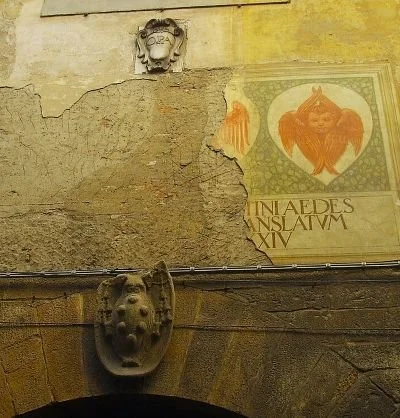
Fig.1 Via dello Studio (portaal)
In 1341 had het stadsbestuur voor de Studio Fiorentino nog een budget voorzien van 2.500 fiorini. Er zullen toen een 10-tal docenten geweest zijn voor een 50-tal studenten. Bij de opstart van de samengevoegde universiteit (zie verder) was er in 1473 sprake van 6.000 f. Rekening houdend met o.a. de inflatie en de stijging van de salarissen was dat budget uiteindelijk slechts 1,5 keer groter dan dat van 1341.
Ook de buren van Pisa hadden met een pauselijke bulle in 1343 een studium generale gekregen en dus ook op dat vlak waren de 2 steden concurrenten geworden. Nadat de Florentijnen in 1406 Pisa veroverd hadden ging de Studio er daar zienderogen op achteruit. Maar ook de Studio Fiorentino zelf zat in slechte financiële papieren en trok nog weinig studenten aan.
Dat was niet het geval voor de Studio Senese (gesticht in 1240 en erkend door de keizer in 1357 en de paus in 1408) die in de 15de eeuw een bloeiperiode beleefde (vooral in de faculteiten van de rechten en de geneeskunde) en toen een veilig en stabiel alternatief was voor de Toscaanse studenten.
2. Het samenwerkingsverband in de 15de eeuw:
Reeds in 1429 hadden de ufficiali van de Studio Fiorentino er op gewezen dat er 200 à 250 zonen van Florentijnen studeerden in het buitenland. Dat kon afgeleid worden uit de catasto wanneer men een belastingaftrek kreeg voor studerende zonen. Op die manier liet de Florentijnse schatkist per jaar ca. 5.000 f. liggen en om de studenten in eigen huis te houden was een samenwerkingsverband van Pisa met Firenze wellicht een oplossing, maar uiteindelijk besliste Lorenzo de’ Medici pas in 1473 om het studium generale over te dragen naar Pisa en in Firenze enkel de studia humanitatis (de humaniora) te behouden (zie art. Lo Studio Fiorentino en de Medici).
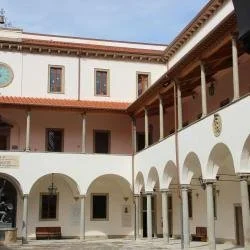
Fig. 2 Palazzo della Sapienza Pisa
Rechten, geneeskunde en filosofie werden overgeheveld naar Pisa en in Firenze werden nog klassieke talen, letteren, retorica en poëzie onderwezen. Het was geen echte fusie, maar il Magnifico had een bifocale instelling met 2 gespecialiseerde locaties opgericht. Men zou in moderne bewoordingen kunnen spreken van een “campus Pisa” (zie fig.2) en een “campus Firenze”.
In Firenze bleef ook nog wel het Collegio Teologico bestaan, een theologische instelling die sterk verbonden was met de religieuze orden van Santa Maria Novella, San Marco, Santa Croce en Santo Spirito, maar die los stond van de Studio Fiorentino.
Met het samengaan in 1473 werd het Studium generale in Pisa heropgericht als de Studio Pisano, de naam bleef dus behouden, maar het bestuur werd onder Florentijns toezicht geplaatst met de 5 door Firenze aangewezen ufficiali dello Studio. Zij hadden dus zowel in Pisa als in Firenze bevoegdheid. De rector en de vice-rector werden niet meer verkozen door de studenten (zoals dat in Pisa vóór 1473 gebeurd was) maar aangesteld door het Florentijnse stadsbestuur. Het zwaartepunt van de onderwijsactiviteit lag in Pisa, maar de controle gebeurde vanuit Firenze.
Zoals reeds vermeld werd er in 1473 een budget voorzien van 6.000 f., maar van de Pisanen werd verwacht dat zij de Studio mee gingen financieren. Dat kon o.a. met een taks te heffen op de consumptiegoederen (de gabella). Met pauselijke toelating mocht de republiek Firenze ook een belasting heffen op de Florentijnse geestelijkheid die dan moest aangewend worden voor de werking van de Studio en het betalen van de salarissen. Paus Sixtus IV had in 1475 beslist het jaarlijks bedrag vast te leggen op 5.000 f. en dat besluit werd telkens verlengd tot in 1498. De docenten in Firenze werden minder betaald dan hun collega’s in Pisa.
In Pisa werd er in 1473 gestart met 175 studenten en 27 docenten. Bij die laatsten waren o.a. Piero Leoni en Alessandro Sermoneta (praktische en theoretische geneeskunde) en Bartolommeo Sozzini (civiel recht). Aan de kleine afdeling van de studia humanitatis in Pisa gaf Lorenzo Lippi Latijnse retorica (1). In Firenze, waar het zwaartepunt van de humanistische vorming lag, zullen dat nog 4 à 5 docenten voor een 50-tal studenten geweest zijn. De bekendste lesgevers waren daar toen Cristoforo Landino (Latijnse poëzie) en Agnolo Poliziano (Grieks & Latijnse retorica).
Maar oorlogsomstandigheden en epidemieën kwamen roet in het eten strooien. Omwille van een pestplaag werd er van 1478 tot 1480 vanuit Pisa uitgeweken naar Pistoia en in 1482 en 1486 verhuisde men naar Prato. In die steden, die op Florentijns territorium lagen, werd meestal in kloosters les gegeven aangezien er geen echte universiteitsgebouwen bestonden.
Toen in november 1494 Pisa bezet werd door de troepen van de Franse koning Karel VIII kwamen de Pisanen meteen in opstand tegen de Florentijnen. De Medici waren op datzelfde moment uit Firenze verbannen en het nieuwe bestuur (onder leiding van de boeteprediker Girolamo Savonarola) besloot eerst om de gebeurtenissen af te wachten, maar besliste dan toch, uit veiligheidsoverwegingen om in februari/maart 1495 vanuit Pisa naar Prato te verhuizen. De Studio Pisano kon niet meer functioneren en de deuren werden gesloten.
De medicus Lorenzo Lorenzi, die zelf aan de Studio Pisano gestudeerd had, was één van die lesgevers in Prato (1495-96) die daarna (1496-1502) in Firenze praktische geneeskunde gedoceerd heeft.
Wanneer dan in Prato de pest uitbrak in de lente van 1497 werd de Studio Pisano opnieuw getransfereerd naar Firenze (zie art. Girolamo Savonarola en lo Studio Fiorentino).
Sommige politici, zoals Francesco Valori, vonden dat men geen geld meer moest pompen in de Studio Pisano of waren van oordeel dat Firenze zo’n overbrenging verplicht was aan zijn culturele status, maar anderen, zoals Bernardo Rucellai, beweerden dat men op dat moment het geld beter kon gebruiken om oorlog te voeren tegen Pisa. Maar als men de onderwijsactiviteiten stopte kon er ook geen beroep meer gedaan worden op de opbrengst van de kerkelijke belastingen ten bedrage van 5.000 f. en uiteindelijk werd er op 27 september 1497 toch besloten om de overstap goed te keuren.
Er was weinig enthousiasme, zowel bij de docenten als bij de studenten, om in de stad van Savonarola aan de slag te gaan. Enkel de Florentijnen waren verplicht huiswaarts gekeerd en vele niet-Florentijnen waren uit vrees voor het regime van de boeteprediker uitgeweken naar andere steden en universiteiten.
De overgebleven docenten (zoals Marcello Adriani) bleven in loondienst van de Studio en gaven hun lessen in de vorm van openbare lecturae (voorlezingen en commentaren) in gehuurde of stedelijke ruimtes in de stad. Dit deden zij voor een publiek van leergierige jongeren (zoals Francesco Guicciardini, Niccoló Machiavelli en Pietro Crinito) en andere belangstellenden. Op hun loon moesten de profs dikwijls heel lang wachten en meestal werden zij niet betaald in cash maar met schuldbrieven.
Reeds in december 1494 had Savonarola 5 nieuwe Ufficiali delle Studio aangesteld, die zware bezuinigingen moesten doorvoeren en de overbrenging in 1495 naar Prato moesten organiseren.
Ondanks hun inspanningen ging het met de Studio gedurende de volgende jaren compleet bergafwaarts (het totale budget bedroeg geen 5.000 f. meer), maar het theologisch college kende (met 250 studenten) zijn topjaren.
3. De heropleving in de 16de eeuw:
Tijdens het gonfalonaat van Piero Soderini begon in 1502 een geleidelijke heropleving. Hij rekende op zijn politieke vrienden en ufficiali Gino Capponi, Lorenzo Ridolfi en Niccoló Valori om de Studio weer financieel gezond te maken. De opbrengst van de zoutbelasting werd nu rechtstreeks gekoppeld aan het budget van de Studio. Hij overtuigde de profs die nog in Firenze waren om opnieuw aan de slag te gaan, met de belofte dat zij nu effectief zouden betaald worden, en er werden ook nieuwe lesgevers aangesteld zoals Francesco Cattani da Diacetto, die filosofie ging doceren. Maar de pauselijke inkomsten was de Studio kwijt.
Soderini wilde de activiteiten in Pisa (rechten, geneeskunde en filosofie) terug op gang brengen, maar aangezien dat onmogelijk was omdat Pisa nog steeds een rebellerende stad was, moest er ondertussen weer uitgeweken worden naar Pistoia en Prato of bleef men in Firenze. Zo gaf Luca Pacioli zijn wiskundelessen in Firenze terwijl hij benoemd was aan de Studio Pisano.
In 1509 werd Pisa heroverd. Met de terugkeer van de Medici in 1512 en de geldelijke steun van paus Leo X (Giovanni de’ Medici) konden in Pisa eindelijk de deuren weer geopend worden in 1515, maar in de volgende decennia kwam het universitaire onderwijs weer grotendeels tot stilstand, zowel in Pisa als in Firenze ten gevolge van politieke onrust (het opnieuw verjagen van de Medici in 1527) en oorlogsomstandigheden (met de belegering en inname van Firenze in 1529/30 door de troepen van de keizer). De onderwijsactiviteiten werden in 1535 andermaal stopgezet wegens gebrek aan middelen en voorzieningen. Oorlog voeren was nog altijd belangrijker dan studeren en zowel in Firenze als in Pisa veroorzaakten de financiële problemen een leegloop van studenten en docenten naar Padua, Bologna en Siena.
Pas in 1543 zorgde hertog Cosimo I voor de heropleving en reorganisatie van de Studio Pisano met nieuwe statuten en voldoende middelen. Het zwaartepunt van de studies lag terug in Pisa en in Firenze bleven enkel een aantal taalkundige en literaire onderwijsactiviteiten bestaan. In 1571 kwam er in Firenze wegens Cosimo’s persoonlijke interesse nog wel een leerstoel wiskunde bij, die ingevuld werd door de cartograaf Ignazio Danti.
Cosimo I liet na de inname van Siena in 1555 de plaatselijke universiteit bestaan. Hij hoopte om met het behoud van de intellectuele vrijheid opstanden te voorkomen, maar verplichtte de Florentijnen om in Pisa te gaan studeren. Dank zij eigen inkomsten die de karige dotatie uit de kas van de groothertog (2.600 scudi) moesten aanvullen had de Studio Senese net genoeg financiële middelen om te overleven.
De ufficiali bleven bestaan tot in het midden van de 18de eeuw, maar Cosimo I had hun macht reeds 2 eeuwen vroeger uitgehold. In 1543 had hij een provveditore aangesteld (zijn verre neef Chiarissimo di Bernardo de’ Medici) die de rector verving en de auditore (Lelio Torelli) was een soort minister van onderwijs.
Na de reorganisatie in 1543 kwam het geld voor de Studio uit de staatskas van de hertog van Toscane, zodat er meer en meer sprake kon zijn van een staatsuniversiteit. Terwijl Lorenzo de’ Medici in 1473 nog een toelage van 6.000 fiorini voorzien had, zorgde Cosimo I in 1543 voor een budget van 10.000 scudi dat snel verhoogd werd tot 15.000 (2). Hij moest rekening houden met een populatie van 30 docenten en 300 à 400 studenten in Pisa en Firenze samen.
Ondanks de muntschommelingen en de inflatie lagen, in termen van reële waarde en koopkracht, deze budgetten vrij dicht bij elkaar. Het leeuwenaandeel van de centen ging nog altijd naar de docentensalarissen die in de 16de eeuw nog grotere verschillen vertoonden dan voorheen. Een topdocent (jurist) kon 20 tot 30 keer het jaarloon van een geschoold arbeider (35 à 40 florijnen) verdienen. De beginnende docenten haalden soms niet eens die 40 f. en in 1543 hadden zij het zelfs nog moeilijker dan hun collega’s in 1473.
Men kon natuurlijk wel carrière maken en snel opklimmen op de financiële ladder. De “waarde” van een professor werd mede bepaald door het aantal studenten dat bij hem les volgde. De naam van de lesgever was belangrijker dan de naam van de universiteit, vandaar dat het binnen halen van een gerenommeerde docent van kapitaal belang was, zelfs als daar een astronomisch loon aan vast zat.
4. De stagnatie en de verschuivingen in de 17de en 18de eeuw:
Na de heropleving onder Cosimo I werden de eerste tekenen van achteruitgang merkbaar in het eerste kwart van de 17de eeuw. De groothertogen investeerden minder in de Studio Pisano en hadden meer aandacht voor de academies die van Firenze het intellectuele centrum van Toscane maakten. Vele leden van die academies (zoals de classici Piero Vettori en Carlo Roberto Dati) gaven ook nog les in wat men het restant van de Studio Fiorentino zou kunnen noemen.
De Florentijnse academies, die nu een 2de kanaal vormden voor hoger onderwijs en onderzoek, hadden hun eigen wetten en aan het hoofd van een academie stond een principe die werd bijgestaan door censori. Naast de staatsacademies (Accademia Fiorentina 1541), de privé-academies (Accademia della Crusca 1583) waren er ook de prinselijke academies (Accademia del Cimento 1657) die op initiatief van de Medici opgericht waren. In de academies werd niet klassikaal les gegeven, maar er werden lezingen gehouden, ook door professoren van de vroegere Studio Fiorentino en vice versa.
De Studio Pisano bleef gedurende de 17de eeuw gewoon verder bestaan en was nog steeds de officiële universiteit van de groothertogen, maar verloor stilaan hun interesse. Rond het midden van de 17de eeuw werd er voor de 30 à 35 docenten en de 400 à 500 studenten van de Studio Pisano een budget van 15.000 à 20.000 scudi voorzien, dat bijna volledig opgesoupeerd werd door salarissen en dat in monetaire waarde niet veel groter was dan dat van 1550.
Sommige academies kregen ook rechtstreekse staatssteun (zoals de Accademia del Disegno) en andere (zoals de Accademia del Cimento) bestonden dankzij eigen middelen (via privédonaties) en bijdragen uit hun academisch werk.
Onder de groothertogen uit het Huis van Lorreinen, die de Medici in 1737 waren opgevolgd, was in 1752 het universiteitsbudget gestegen tot 28.000 scudi met een bezetting van 40 docenten en ca. 600 studenten. Dat was 1,5 keer groter dan dat van 1650 en er kon nu ook geïnvesteerd worden in moderne infrastructuur dankzij het optreden van provveditore Gaspare Cerati.
Maar toch werd in 1784 de Studio Fiorentino als instituut (sedert 1473 een onderdeel van de Studio Pisano) definitief opgeheven. Om geen profs te moeten ontslaan konden de lessen in Toscaanse taal, moraalfilosofie, Grieks, wiskunde en recht nog doorgaan in de Biblioteca Marucelliana. Groothertog Pier Leopoldo wilde geen 2 staatsuniversiteiten naast elkaar en vond dat de structuur van Pisa beter geschikt was dan die van Firenze. De Studio Senese mocht blijven bestaan, maar werd grondig gereorganiseerd. Er werd daar nu gefocust op exacte wetenschappen en “verlicht” recht. Voor de financiering moest de Monte dei Paschi zorgen.
In Firenze werden de verschillende academies omgevormd tot gespecialiseerde onderzoekscentra .
5. Van een technische hogeschool in de 19de eeuw tot een volwaardige universiteit in de 20ste en 21ste eeuw:
Tijdens de Franse periode werd in Firenze in 1807 het Liceo di Scienze Fisiche e Naturali opgericht, een nieuwe instelling (geen voortzetting van de Studio) waar voornamelijk de natuurwetenschappen aan bod kwamen. Toen die ophield te bestaan in 1814 werd het wetenschappelijk onderzoek verder gezet in instellingen zoals de Scuola di Farmacia het ziekenhuis van Santa Maria Nuova, het Museo di Fisica e Storia Naturale (La Specola) en de Scuola tecnica di arti e manifatture (de technische school voor kunsten en ambachten).
In Pisa werd naast de universiteit (die een keizerlijke Napoleontische academie werd) in 1810 de Scuola Normale Superiore opgericht, de lerarenopleiding die nog steeds een aparte status heeft. In Siena werd de universiteit die door de Fransen gesloten was in 1808 heropend in 1814.
Tijdens het gerestaureerde bewind van Lorreinen werd ook nog het Liceo Fiorentino opgericht dat zich vooral toelegde op praktische vorming van de juristen. De faculteit van de rechten bleef in Pisa.
Het risorgimento en de opname van Toscane in het nieuw gevormde Italië stelde een einde aan de heerschappij van de groothertogen van Lorreinen die de Studio gesloten hadden.
Inzake onderwijs kwam de grote verandering er in december 1859 toen in Firenze het Istituto di Studi Superiori Pratici e di Perfezionamento (met 4 hoofdafdelingen: medicijnen & chirurgie, filosofie & filologie, natuurwetenschappen en rechten) werd opgericht op initiatief van Cosimo Ridolfi, minister van onderwijs van de voorlopige Toscaanse regering. Dat was het resultaat van de samenvoeging en opwaardering van een aantal instellingen voor hoger onderwijs, wetenschappelijke collecties en humanistische en filologische academies uit de vorige eeuwen. De hoofdzetel, de Sapienza op de Piazza San Marco werd uitgebreid met gebouwen in de naburige straten. Hier is nog steeds het rectoraat van de huidige universiteit gevestigd.
Het instituut werd geleid door een raad van bestuur met een president die moest zorgen voor de logistiek, de benoemingen, de leerplannen en de interactie met de overheid. De academische raad van professoren had enkel een adviserende bevoegdheid.
Omdat het jonge Italiaanse koninkrijk het Istituto di Studi Superiori Pratici e di Perfezionamento aanvankelijk niet volledig als een officiële nationale universiteit wilde erkennen (en dus niet volledig wilde subsidiëren), werd in 1872 het Consorzio ingevoerd, een overeenkomst waarbij het instituut gezamenlijk gefinancierd werd door de Italiaanse staat, de provincie Firenze en de gemeente Firenze.
In 1859 werd er een startbudget voorzien van 85.000 lire dat snel werd opgeschaald naar 408.000 lire (3). Men was toen van start gegaan met 24 docenten en 64 studenten.
Ernestina Punitz-Paper was de eerste vrouw die een diploma behaalde in medicijnen & chirurgie in Italië. Zij studeerde in Pisa en dan in Firenze (aan het Istituto) waar zij in 1877 haar laurea kreeg. Zij was tevens de eerste gediplomeerde arts in Italië (4).
De officiële erkenning van het instituut als Università degli Studi di Firenze kwam er pas in 1924. Dat de toenmalige minister van onderwijs, Giovanni Gentile, een Florentijn was, zal daar zeker niet vreemd aan geweest zijn. De stad van de renaissance zag de wedergeboorte van haar universiteit dus pas in de 20ste eeuw.
De academische raad werd nu een volwaardig bestuursorgaan (Senato Accademico) en de academische rector (gekozen uit de docenten) kreeg de leiding over zowel de administratie als de wetenschappelijke en didactische koers van de universiteit.
Er werd les gegeven in het hoofdgebouw op de Piazza San Marco en in de bijgebouwen van de Via Laura, Via Capponi en Via Ricasoli. De medische faculteit kon terecht in het Ospedale di Santa Maria Nuova.
In 1924 bedroeg het budget al 3 miljoen lire. In termen van reële waarde was dat budget echter slechts 1,4 keer groter dan dat van 1859. Maar het aantal docenten was gestegen naar 80 en het aantal studenten was gestegen naar 1250. Die aantallen zijn nog relatief klein omdat er gestart werd met een nieuwe universitaire instelling. De universiteit van Pisa had in 1924 ongeveer een gelijkaardig aantal studenten en docenten. Door de Wet Gentile werd de universiteit van Siena beschouwd als type B en had minder subsidies en dus ook minder docenten en studenten.
Sedertdien bestaan de universiteiten van Firenze en Pisa onafhankelijk naast elkaar en zijn zij samen met Siena de 3 staatsuniversiteiten van Toscane.
De UNIFI telt momenteel geen faculteiten meer maar 10 scuole en 21 departementi en de verschillende campussen zijn gelegen in Firenze zelf, Sesto Fiorentino, Empoli, Prato en Pistoia. Het is een reguliere, volledig door de nationale overheid gefinancierde staatsuniversiteit geworden. Momenteel bedraagt het budget 535 miljoen euro, dat is 162 keer groter dan dat van 1924. Maar er zijn dan ook 55.000 studenten en ca. 1800 academische medewerkers.
De UNIPI van Pisa heeft geen faculteiten, maar 20 departementen. De universitaire zones liggen bijna allemaal in Pisa zelf. De instelling heeft nu een budget van 367 miljoen euro, voor 45.000 studenten en 1750 personeelsleden.
De UNISI van Siena heeft 9 scholen met 15 departementen die gelegen zijn in het historisch centrum van de stad en moet het stellen met een budget van 200 miljoen voor 17.000 studenten en 800 medewerkers.
De bescheiden Studio Fiorentino, ooit nog het overblijfsel van de Studio Pisano, is na vele eeuwen uitgegroeid tot een gerenommeerde instelling die een plaats heeft in de top 10 van de Italiaanse universiteiten en Pisa en Siena overvleugeld heeft.
(1) Er werden in beide studio’s nog gemeenschappelijke (ondersteunende) vakken gedoceerd. Zo werd er in Firenze nog medische filosofie en in Pisa taalonderwijs gegeven. Maar Pisa bezat het monopolie op de formele graden in Recht en Medicijnen en Firenze behield de intellectuele dominantie en geavanceerde leerstoelen in de Humaniora. In de humanistische vakken kon men geen diploma krijgen en vanaf 1473 werden er dus geen diploma’s meer uitgereikt aan de Studio Fiorentino.
(2) In de teksten en documenten worden geregeld de munteenheden van fiorino, scudo en ducato d’oro door elkaar gebruikt. In de 16de eeuw mag men er van uitgaan dat zij alle 3 ongeveer dezelfde waarde hadden. In de 17de eeuw was de gouden dukaat (of zecchino) al 1,5 zilveren scudi (schilden) waard en in de 18de eeuw was dat gestegen tot 2,5 scudi.
(3) In 1859 was 1 gouden dukaat het equivalent van 12,23 lire en 1 Toscaanse scudo kwam overeen met 5,6 Italiaanse lire. Het startbudget in 1859 van 85.000 lire kan dus omgezet worden naar 15.178 zilveren scudi en 6.950 gouden dukaten. Hoewel 85.000 lire op papier een veel groter getal lijkt dan de 28.000 scudi van 1752 , werd dit volledig tenietgedaan door de enorme inflatie en devaluatie van het zilver in de tussentijdse 107 jaar. Het budget van 1752 was in werkelijkheid bijna twee keer zo ruim. Vandaar de snelle en noodzakelijke budgetverhogingen vanaf 1859.
(4) Zij werd vooraf gegaan door Elena Cornaro (Padua) en Laura Bassi (Bologna) allebei gegradueerd in filosofie in 1678 en 1732. Bassi werd ook de eerste vrouwelijke universiteitsprofessor in Europa.
JVL
How the Studio Fiorentino became a fully qualified university.
1. Founding and evolution in the 14th century:
Florence had become a rich and powerful trading city in the 14th century and also wanted to become an important centre of education and knowledge. In 1321, the city council of Florence had started a studium generale with the required faculties: civil and canon law, medicine and the arts. But due to money problems and the lack of the necessary recognitions (which were vital to attract professors and students), the Studio was temporarily closed after only 3 years.
The reopening followed in 1349 with the papal approval and the granting of privileges (the awarding of diplomas) by Clement VI. A faculty of theology was now also established, which later evolved into the Collegio Teologico. According to chronicler Filippo Villani, who himself taught civil law in the 1360s, the first laureate in theology was the Augustine fra Francesco di Biancozzo de' Nerli in 1359. The first professor at the Studio was most likely Cino da Pistoia, who taught Roman law in 1321.
Imperial approval followed in 1364 with a decree by Charles IV, and in 1387 the institution received new statutes and a Greek professorship was set up, the first in Western Europe. The faculty of medicine received 2 corpses (of executed convicts) per year for the anatomical research.
In 1385, the administrative framework of the Studio Fiorentino was formed: 8 ufficiali (or reformatores) were members of a one-year administrative committee, appointed by the city council (the Signoria), that was responsible for attracting and appointing teachers, determining their salaries, installing professorships, enforcing the statutes (laid down in 1388) and resolving conflicts. The rector was elected by his predecessor and his rectoral council that assisted him consisted of a number of students from the various faculties.
Those 8 ufficiali (2 from each city quarter, of which 1 from the large guilds and 1 from the small ones) were mostly men who had political experience and had served on other councils, but they would not all have been education experts. In 1455 the number of ufficiali was reduced from 8 to 5 (1 from each city quarter and 1 representative of a small guild) (see art. Lo Studio Fiorentino and the Medici).
The ufficiali also had to take care of finding suitable classrooms and housing for the students. Education still took place at various locations in the centre of Florence and the city council rented houses or rooms from citizens where teachers could meet their students. The rent was paid by the city or with the tuition fees of the students. Lessons were also given in monasteries or church buildings (such as Santa Maria Novella and Santa Croce) where there was usually also a library.
From 1392 onwards, lessons took place in the Palazzo dello Studio, a building confiscated by the city that had been owned by the Ghibelline Tebaldini family and which is still located in the Via dello Studio at no. 1 (a side street near the cathedral square) (see fig.1).
In 1341, the city council had provided a budget of 2,500 fiorini d’ oro for the Studio Fiorentino. There must have been then about 10 teachers for about 50 students. At the start of the new university in 1473 (see below), the budget raise to 6,000 f. Taking into account inflation and the increase in salaries, that budget was ultimately only 1.5 times larger than in 1341.
The neighbours of Pisa had also received a studium generale with a papal bull in 1343 and so the 2 cities had also become competitors in that area. When the Florentines conquered Pisa in 1406, the Studio Pisano visibly declined. But also the Studio Fiorentino was in financial troubles and attracted few students.
This was not the case for the Studio Senese (founded in 1240 and recognized by the emperor in 1357 and the pope in 1408), which flourished in the 15th century (especially the faculties of law and medicine) and was then a safe and stable alternative for Tuscan students.
2. Cooperation in the 15th century:
As early as 1429, the ufficiali of the Studio Fiorentino had pointed out that there were 200 to 250 sons of Florentines studying abroad. This could be derived from the lists of the catasto when a tax deduction was given for studying sons. In this way, the Florentine treasury was missing about 5,000 f. per year and in order to keep the students in Florence, a partnership with Pisa might have been the solution, but in the end it was not until 1473 that Lorenzo de' Medici decided to transfer the studium generale to Pisa and to keep only the studia humanitatis (the humaniora) in Florence (see art. Lo Studio Fiorentino and the Medici).
Law, medicine and philosophy were transferred to Pisa and classical languages, literature, rhetoric and poetry were still taught in Florence. It was not a real merger, but il Magnifico had created a bifocal institution with 2 specialized locations. In modern terms, one could speak of a "Pisa campus" (see fig.2) and a "Florence campus".
In Florence the Collegio Teologico, strongly linked to the religious orders of Santa Maria Novella, San Marco, Santa Croce and Santo Spirito was still existing as a separate institution.
in 1473, the Studium generale in Pisa was re-established as the Studio Pisano, so the name was retained, but the administration was placed under Florentine supervision with the 5 ufficiali dello Studios appointed by the city of Florence. They had jurisdiction in Pisa as well as in Florence. The rector and vice-rector were no longer elected by the students (as had been the case in Pisa before 1473) but appointed by the Florentine city council. The main focus of the educational activity was in Pisa, but the control was done from Florence.
As already mentioned, the Studio received a budget of 6,000 f. but the Pisans were expected to make a financial contribution. This could be done, amongst other things, by levying a tax on consumer goods (the gabella). With papal permission, the republic was also allowed to levy a tax on the Florentine clergy that had to be used for the functioning of the Studio and the payment of salaries. Pope Sixtus IV had decided in 1475 to set the annual amount at 5,000 f. and this decision was extended until 1498. Teachers in Florence were less paid than their colleagues in Pisa.
Pisa started in 1473 with 175 students and 27 teachers. Among the latter were Piero Leoni and Alessandro Sermoneta (teaching practical and theoretical medicine) and Bartolommeo Sozzini (civil law). At the small department of the studia humanitatis in Pisa, Lorenzo Lippi taught Latin rhetoric (1). But the main focus of humanist education was still in Florence where there would have been 4 to 5 teachers for about 50 students. The most famous teachers there were Cristoforo Landino (Latin poetry) and Agnolo Poliziano (Greek & Latin rhetoric). From 1473 onwards no more diplomas were awarded in the Studio Fiorentino.
But war and epidemics came to spoil things. Because of the plague, the university of Pisa moved to Pistoia from 1478 to 1480 and in 1482 and 1486 it moved to Prato. In those cities, which were located on Florentine territory, lessons were usually given in monasteries since there were no real school buildings.
When Pisa was occupied by the troops of the French king Charles VIII in November 1494, the Pisans immediately rebelled against the Florentines. The Medici had been banished from Florence and the new government (led by the penitential preacher Girolamo Savonarola) first decided to wait for events, but then decided, for security reasons, to move from Pisa to Prato in February/March 1495. The Studio Pisano could no longer function and its doors were closed.
The physician Lorenzo Lorenzi, who himself had studied at the Studio Pisano , was one of those teachers in Prato (1495-96) who then (1496-1502) taught practical medicine in Florence.
When the plague broke out in Prato in the spring of 1497, the Studio Pisano was again transferred to Florence (see art. Girolamo Savonarola and lo Studio Fiorentino).
Some politicians, such as Francesco Valori, argued that money should no longer be put into the Studio Pisano and that Florence was obliged to make the takeover due to its cultural status, while others, such as Bernardo Rucellai, claimed that it would be better to use the money to finance the war against Pisa. But when the educational activities were stopped, the proceeds of the church taxes amounting to 5,000 f. were lost as well and so, on September 27, 1497, it was decided to approve the shift.
There was little enthusiasm, both among instructors and students, to live and work in the city of Savonarola. Only the Florentines were obliged to return home and many non-Florentines had moved to other cities and universities for fear of the regime of the penitential preacher.
The few remaining professors of the Studio (such as Marcello Adriani) gave public lecturae (lectures and commentaries) in rented or urban spaces in the city for an audience of inquisitive young people (such as Francesco Guicciardini, Niccoló Machiavelli and Pietro Crinito) and interested parties. They often had to wait a very long time for their wages and most of the time they were not paid in cash but with debt notes.
Already in December 1494, the frate had installed 5 new ufficiali who had to make severe budget cuts and prepare the transfer in 1495. In spite of their efforts the Studio went completely downhill during the following years (the global budget was even less than 5,000 f.), while the theological college (with 250 students) enjoyed its peak years.
3. The revival in the 16th century:
When gonfaloniere Piero Soderini took over the government, a gradual revival began in 1502. With the support of his political friends and ufficiali Gino Capponi, Lorenzo Ridolfi and Niccoló Vallori he could restore the Studio's financial situation. The proceeds of the salt tax were now directly linked to the Studio's budget. He convinced the professors who were still in Florence to continue their activities in the Studio, with the promise that they would actually be paid this time. New teachers were also appointed such as Francesco Cattani da Diacetto, who started teaching philosophy. But the Studio had lost the papal tax income .
Soderini wanted to restart the activities in Pisa (law, medicine and philosophy), but since that was impossible because Pisa was still a city in rebellion, one had to stay in Florence or move to Pistoia and Prato. Luca Pacioli, for example, taught his mathematics classes in Florence while he was appointed to the Studio Pisano.
Pisa was reconquered in 1509. With the return of the Medici in 1512 and the financial support of Pope Leo X (Giovanni de' Medici), Pisa was finally able to open its doors again in 1515, but in the following decades university education came to a standstill, as well in Pisa as in Florence as a result of the re-expulsion of the Medici in 1527 and the siege and capture of Florence by the imperial forces in 1529/30. Educational activities were again stopped in 1535 due to lack of resources and facilities. Going to war was still more important than studying and both in Florence and in Pisa the financial problems caused an exodus of students and teachers towards Padua, Bologna and Siena.
It was not until 1543 that Duke Cosimo I took care of the revival and reorganization of the Studio Pisano by giving it new statutes and more facilities. The focus of the studies was back in Pisa and only a few linguistic and literary teaching activities continued to exist in Florence. However, in 1571, due to Cosimo’s personal interest and passion a chair of mathematics was added in Florence, which was occupied by the cartographer Ignazio Danti.
When Siena was taken in 1555, Cosimo I did not close the local university. He hoped to prevent revolts by preserving the intellectual freedom of the Sienese, but obliged the Florentines to study in Pisa. Thanks to own resources which had to complement the meagre endowment from the Grand Duke's treasury (2,600 scudi), the Studio Senese had just enough money to survive.
The ufficiali were still in charge until the middle of the 18th century, but Cosimo I had already eroded their power 2 centuries earlier. In 1543 he had appointed a provveditore (his distant cousin Chiarissimo di Bernardo de' Medici) who replaced the rector and the new auditore (Lelio Torelli) was a kind of ducal minister of education.
With the reorganization in 1543, the Studio became a real state university since the money came entirely from the ducal treasury.
While Lorenzo de' Medici had provided for an allowance of 6,000 fiorini in 1473, Cosimo I provided a budget of 10,000 scudi in 1543, which was quickly increased to 15,000 (2). There was a total number of 30 teachers and 300 to 400 students in Pisa and Florence.
Despite currency fluctuations and inflation, in terms of real value and purchasing power, these budgets were quite close to each other. The lion's share of the money still went to teachers' salaries, which in the 16th century showed even greater differences than before. A top teacher (lawyer) could earn 20 to 30 times the annual wage of a skilled craftsman (35 to 40 florins). Starting teachers sometimes did not even had that 40 f. and in 1543 they were worse off than their colleagues in 1473.
One could off course make a career and climb the financial ladder quickly. The "value" of a professor was partly determined by the number of students who took lessons with him. The name of the lecturer was more important than the name of the university, which is why bringing in a renowned lecturer was of paramount importance, even if it came with an astronomical salary.
4. The stagnation and conversions in the 17th and 18th centuries:
After the revival under Cosimo I, the first signs of decline became noticeable in the first quarter of the 17th century. The Grand Dukes invested less in the Studio Pisano and paid more attention to the academies that made Florence the intellectual centre of Tuscany. Many members of those academies (such as the classicists Piero Vettori and Carlo Roberto Dati) were also teaching in what was left of the Studio Fiorentino.
The Florentine academies, which formed now a second channel for higher education and research, had their own regulations and at the head of an Accademia was a principe, assisted by censori. In addition to the state academies (Accademia Fiorentina 1541) and the private academies (Accademia della Crusca 1583), there were also the princely academies (Accademia del Cimento 1657) that were founded on the initiative of the Medici. Now and then professors of the Studio Fiorentino gave lectures in the academies and vice versa.
The Studio Pisano continued to exist throughout the 17th century and was still the official university of the Grand Dukes, but gradually they lost interest. In the middle of the 17th century, a budget of 15,000 to 20,000 scudi was provided for the 30 to 35 teachers and the 400 to 500 students of the Studio Pisano, which was almost entirely consumed by salaries and which was not much greater in monetary value than that of 1550.
Some academies also received direct state support (such as the Accademia del Disegno) and others (such as the Accademia del Cimento) had their own resources, through private donations and contributions.
Under the Grand Dukes of the House of Lorraine, who had succeeded the Medici in 1737, the university budget had risen to 28,000 scudi in 1752 with a population of 40 teachers and about 600 students. That was 1.5 times larger than that of 1650 and it was now also possible to invest in modern infrastructure, thanks to the reorganization by provveditore Gaspare Cerati.
Nevertheless in 1784 the Studio Fiorentino was definitively dissolved as an institute (that was part of the Studio Pisano since 1473). In order not to have to fire professors, the lessons in Tuscan language, moral philosophy, Greek, mathematics and law could still take place in the Biblioteca Marucelliana.
Grand Duke Pier Leopoldo did not want 2 state universities next to each other and thought that the structure of Pisa was better suited than that of Florence. The Studio Senese did not have to close its doors, but was thoroughly reorganized. The focus was now on exact sciences and “enlightened” law. The Monte dei Paschi had to provide the financing.
In Florence the various academies were transformed into modern specialized research centres.
5. From a technical college in the 19th century to a fully qualified university in the 20th and 21st century:
During the French period, the Liceo di Scienze Fisiche e Naturali was founded in Florence in 1807, a new institution (not a continuation of the Studio) mainly focussed on the study of natural sciences. When it ceased to exist in 1814, scientific research continued in institutions such as the Scuola di Farmacia, the Hospital of Santa Maria Nuova, the Museo di Fisica e Storia Naturale (La Specola) and the Scuola tecnica di arti e manifatture (a technical school of arts and crafts).
In addition to the university of Pisa (which became a Napoleontic imperial academy), the Scuola Normale Superiore opened its doors in 1810. The institution (for teacher training) had a separate status and is still existing now adays. In Siena, the university that had been closed by the French in 1808 was reopened in 1814.
During the reign of Lorraine, the new Liceo Fiorentino was known for the practical training of lawyers, but the Faculty of Law was still in Pisa.
The risorgimento and the incorporation of Tuscany into newly formed Italy put an end to the rule of the Grand Dukes of Lorraine who had closed the Studio Fiorentino.
In terms of education, the big change came in December 1859 when the Istituto di Studi Superiori Pratici e di Perfezionamento (with 4 main departments: medicine & surgery, philosophy & philology, natural sciences and law) was founded in Florence on the initiative of Cosimo Ridolfi, minister of education of the provisional Tuscan government. This was the result of the merger and upgrading of a number of institutions of higher education, scientific collections and humanist and philological academies from the previous centuries.
The headquarters, the Sapienza on Piazza San Marco, was expanded with buildings in the neighbouring streets. The rectorate of the current university is still located here.
The institute was led by a board of directors with a president who had to take care of the logistics, the chairs of professorship, the curricula and the interaction with the government. The academic council of professors only had an advisory power.
Because the young Italian kingdom initially did not want to fully recognize the Istituto di Studi Superiori Pratici e di Perfezionamento as an official national university (and therefore did not want to fully subsidize it), the Consorzio was introduced in 1872, an agreement in which the institute was jointly financed by the Italian state, the province of Florence and the municipality of Florence.
In 1859, a starting budget of 85,000 lire was provided, which was quickly scaled up to 408,000 lire (3). At that time, the institute had 24 teachers and 64 students.
Ernestina Punitz-Paper was the first woman to earn a degree in medicine & surgery in Italy. She studied in Pisa and then in Florence (at the Istituto) where she received her laurea in 1877. She became the first female doctor in Italy (4).
The official recognition of the institute as Università degli Studi di Firenze did not come until 1924. The fact that the Minister of Education, Giovanni Gentile, was a Florentine, was no stranger to this.
So the city of the Renaissance did not see the rebirth of its university until the 20th century.
The academic council now became a fully-fledged governing body (Senato Accademico) and the academic rector (elected from among the teaching staff) was put in charge of both the administration and the scientific and didactic direction of the university. Classes were held in the main building on Piazza San Marco and in the annexes of Via Laura, Via Capponi and Via Ricasoli. The medical faculty found shelter in the Ospedale di Santa Maria Nuova.
In 1924, the budget was already 3 million lire. In terms of fair value, however, that budget was only 1.4 times larger than that of 1859. But the number of teachers had risen to 80 and the number of students to 1250. Those numbers are still relatively small but that was because ii involved a new university. The University of Pisa had a similar number of students and teachers in 1924. Due to the Gentile Act, the University of Siena was considered type B and remained with fewer subsidies and therefore fewer teachers and students.
Since then, the universities of Florence and Pisa have existed independently side by side and together with Siena they are the 3 state universities of Tuscany.
The UNIFI currently has no faculties but 10 scuole and 21 departmenti and the different campuses are located in Florence itself, Sesto Fiorentino, Empoli, Prato and Pistoia.
It is a regular fully nationally funded state university and has now a budget of 535 million euros, which is 162 times larger than in 1924. But then there are also 55,000 students and about 1800 academic staff members.
The UNIPI of Pisa has no faculties, but 20 departments. The university zones are almost all located in Pisa itself. The institution now has a budget of 367 million euros, for 45,000 students and 1750 staff members.
The UNISI of Siena has 9 schools with 15 departments located in the historic centre of the city and has a budget of 200 million for 17,000 students and 800 staff members.
The modest Studio Fiorentino, once the remnant of the Studio Pisano, has grown after many centuries into a renowned institution that has a place in the top 10 of Italian universities, surpassing Pisa and Siena.
(1) Common (supporting) courses were still lectured in both studios. For example medical philosophy was taught in Florence and linguistic lessons were given in Pisa. But Pisa had a monopoly on the formal degrees in Law and Medicine and Florence retained intellectual dominance and advanced chairs in the Humanities. In the humanistic subjects one could not get a diploma. So from 1473 onwards no more diplomas were awarded in the Studio Fiorentino.
(2) In the texts and documents, the currencies of fiorino, scudo and ducato d'oro are regularly used interchangeably. In the 16th century it can be assumed that all 3 had about the same value. In the 17th century, the gold ducat (or zecchino) was already worth 1.5 silver scudi (shields) and in the 18th century this had risen to 2.5 scudi.
(3) In 1859, 1 gold ducat was the equivalent of 12.23 lira and 1 Tuscan scudo was equivalent to 5.6 Italian lira. The starting budget in 1859 of 85,000 lire can therefore be converted into 15,178 silver scudi and 6,950 gold ducats. Although 85,000 lira seems like a much larger number on paper than the 28,000 scudi of 1752, this was completely offset by the enormous inflation and devaluation of silver in the interim 107 years. The budget of 1752 was in reality almost twice as large. Hence the budget increased from 1859 onwards.
(4) She was preceded by Elena Cornaro (Padua) and Laura Bassi (Bologna), both graduates in philosophy in 1678 and 1732. Bassi became the first female university professor in Europe.
Literatuur:
Boutier, J & Paoli, M. Letterati cittadini e prinicpi filosofi. In: Publications de l’Ecole
française de Rome, 355 (2005).
Davies, J. Culture and Power. Tuscany and its Universities. Cambridge, 2009.
Fabbri, L. Un esilio in patria: Lo Studio Fiorentino durante la Guerra di Pisa.
In: Studium Fiorentinum. Rome, 2021.
Grendel, R. The Universities of the Italian Renaissance. Baltimore, 2004.
Van Laerhoven, J. zie art. Girolamo Savonarola en de humanisten van de Studio Fiorentino.
zie art. Lo Studio Fiorentino en de invloed van de Medici.
zie art. Hoe het leven van een universiteitsstudent er uit zag in het
Toscane van het Quattrocento.
Verrde, A. Lo Studio Fiorentino (1473-1503). Firenze, 1973 e.v.