Marsilio Ficino, renaissance filosoof, magiër of ketter (1433-99)?
Marsilio Ficino, renaissance filosoof, magiër of ketter (1433-99)?
Marsilio, uomo universale:
De humanist, priester, filosoof, astroloog, literator, musicus en arts Marsilio Ficino werd op 19 oktober 1433 geboren in Figline Valdarno in het gezin van Diotifeci d’Agnolo di Giusto Ficini en Alessandra di Nanoccio di Montevarchi. Diotifeci was de lijfarts van Cosimo de’ Medici en nadat Marsilio zijn klassieke opleiding in de artes liberales (de vrije kunsten) voltooid had, ging hij, nadat hij 2 jaar in Pisa gestudeerd had, in 1451 les volgen aan de Studio, de Florentijnse Universiteit. Daar kreeg hij o.a. les in filosofie van Niccolò Tognosi da Foligno en ontwikkelde hij een grote interesse voor de Griekse wijsgeren, inzonderheid Plato. Nadat hij reeds enkele werken over filosofie in het Latijn geschreven had kreeg hij van Cosimo de’ Medici (ca. 1460) de raad om Grieks te gaan studeren aan de Studio bij Joannes Agyropoulos, de Byzantijnse geleerde die ter gelegenheid van het oecumenisch concilie van 1439 naar Firenze gekomen was (1).
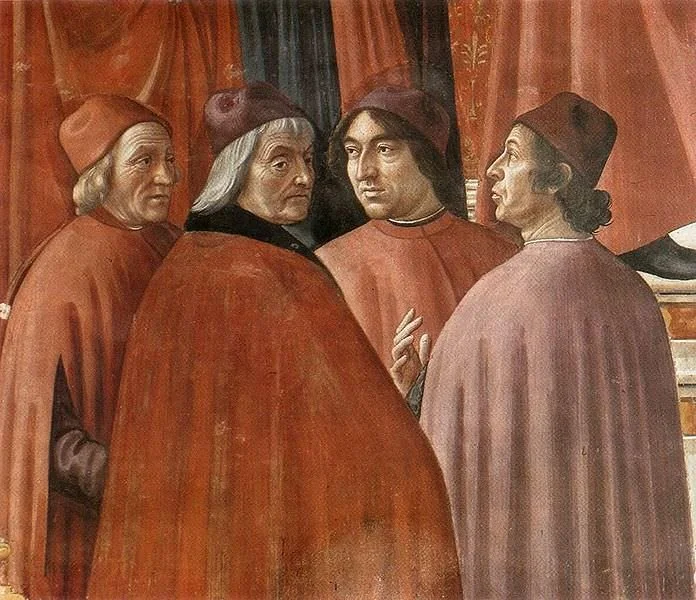
Fig.1 Ficino, Landino, Poliziano (Domenico Ghirlandaio, Santa Maria Novella)
Marsilio en de Accademia Neoplatonica:
Marsilio Ficino is vooral bekend geworden als de leider van de Neoplatonische Academie die Cosimo il Vecchio in 1462 gesticht had. De Medici-bankier zorgde voor de boeken en manuscripten die Ficino nodig had en hij had hem zelfs een woning ter beschikking gesteld in de buurt van de Medici-Villa in Careggi. Samen met de andere leden Cristoforo Landino en Agnolo Poliziano staat hij op een fresco van Ghirlandaio in de Capella Tornabuoni (zie fig.1).
Het was de bedoeling dat de Accademia zich bezig hield met de studie van de filosofie van het neoplatonisme dat een nieuwe impuls gegeven had aan de ideeën van Plato. Het neoplatonisme oefende grote invloed uit op de christelijke theologie in de late oudheid en de middeleeuwen voornamelijk door het werk van Sint Augustinus van Hippo, die werd beïnvloed door de vroege neoplatonisten Plotinus en Porphyrius. De Florentijnse neoplatonisten beschouwden zichzelf als “echte” platonisten en noemden hun groep dan ook de Accademia Platonica.
Marsilio en zijn filosofische ideeën:
De filosofie van Ficino was gebaseerd op 3 belangrijke zuilen: het neoplatonisme, de hermetiek en het christendom. Hij is vooral bekend als navolger van Plotinus (wiens werk hij volledig vertaalde van het Grieks in het Latijn) die het dualisme tussen een bovennatuurlijke wereld en een minderwaardige zichtbare wereld overgenomen had van Plato.
1) Voor de neoplatonist bestaat de realiteit uit 3 lagen of niveaus: bovenaan staat “het Ene”, d.w.z. de oorzaak van al het bestaande (Plato’s “Idee van het Goede”), in het midden bevindt zich het niveau van “de Geest” (de Nous) waar de Ideeën van Plato in thuis horen en onderaan is er “de Ziel” (de onsterfelijke ziel die de Ideeën vóór de geboorte aanschouwd heeft) die ons naar niveau 2 en 1 kan brengen. Ficino schreef hierover in zijn De Vita Libri Tres (1480-89) waarvan een exemplaar bewaard is in de Biblioteca Laurenziana (zie fig.2). dat opgedragen is aan Lorenzo il Magnifico.

Fig.2 De Vita Libri Tres (Manuscipt
Biblioteca Laurenziana, Firenze)
2) Het hermetisme of hermetiek is een hellenistische religie uit de late oudheid, die als doel heeft de mens in te wijden in de verborgen werkelijkheid die zich in en achter de zichtbare werkelijkheid bevindt, om aldus via kennis van zichzelf en het universum tot een intuïtieve godskennis en een persoonlijke, directe godservaring te komen. De meeste geschriften uit de hermetica worden toegeschreven aan de mythische leermeester Hermes Trismegistus. De hermetiek hechtte veel belang aan de astrale invloeden op het menselijk bestaan (de stand van de hemellichamen), zodat Ficino in het vaarwater terecht kwam van de astrologie, waarvan hij ook reeds als medicus het belang inzag. Met zijn interesse voor de hermetica, de alchemie en de astrologie heeft hij ook een belangrijke bijdrage geleverd aan de ontwikkeling van het westerse esoterisme (filosofische stromingen die bedoeld zijn voor ingewijden) in de 15de eeuw.
3) Hij zag overeenkomsten tussen het Evangelie en het Corpus Hermeticum (dat hij volledig vertaald had en de “echte” bijbel noemde) in zijn poging om terug te keren naar de wortels van het christendom. Volgens hem was het christendom gebaseerd op andere, oudere godsdiensten zoals de egyptische, de perzische en de joodse.
Het bestaan van een ziel legde een duidelijke link naar het christendom, zodat men bij Ficino kan spreken van een verchristelijkt platonisme. Hij was van oordeel dat noch het platonisme, noch andere spirituele stromingen en religies noodzakelijkerwijze in strijd moesten zijn met het christendom (hij was tenslotte ook een priester), zodat men hem ook een theosoof zou kunnen noemen (iemand die er vanuit gaat dat elke religie een deel van de waarheid in zich heeft). Deze zienswijze heeft Ficino duidelijk gemaakt in zijn in het Italiaans geschreven werk La Religione Cristiana uit 1476.
Ook in Dante’s Divina Commedia (1308-21) was er al sprake van een wereldbeeld waarin liefde en de menselijke ziel centraal staan en waarbij het de betrachting moet zijn om vanuit het aardse naar het hemelse niveau op te klimmen. Dante liet zich ook al inspireren door de opvattingen van de astrologen, maar hij verwierp hun determinisme, want de mens heeft nog altijd zijn vrije wil.
Marsilio en de astrologie:
Omwille van zijn “verdachte theorieën” in verband met de link tussen het christendom en de astrologie was Ficino in 1489 door paus Innocentius VIII nog beschuldigd van magie (tovenarij) maar die beschuldigingen waren door toedoen van Lorenzo de’ Medici opzij geschoven en er volgde geen veroordeling (2). Planeten kunnen het menselijk lichaam en karakter beïnvloeden en bepaalde planten en zelfs stenen hebben specifieke krachten en muziek, geuren en kleuren kunnen inwerken op de menselijke ziel. Dat muziek de zeden verzacht en zonneschijn de mensen blijgezind maakt zijn oude wijsheden.
Ficino kan een “magiër” genoemd worden, maar dan een natuurlijke magiër, iemand die de geheimen van de natuur probeert te begrijpen en te benutten.
Hij was goed bevriend met de zonen van Pierfrancesco de’ Medici. Aan de toen 15-jarige Lorenzo (later il Popolano) had hij in 1478 geschreven dat “hij bij het ordenen van zijn Luna (d.w.z. de wisselwerking tussen lichaam en geest) teveel (slechte) invloeden van Mars en Saturnus moest vermijden en de gunstige invloeden van Sol (Zon), Jupiter en Venus moest verwerven”. In christelijke taal zou men ook kunnen spreken over het zoeken van een evenwicht tussen het aardse en het goddelijke.
Marsilio en de aardse en goddelijke liefde:
De aardse liefde was voor Ficino de liefde voor lichamelijke schoonheid, de aantrekkingskracht tussen mensen en de verbondenheid via zintuigen en emoties. De goddelijke liefde was de liefde voor de ziel en de geest en uiteindelijk de liefde voor God. De aardse liefde kon dus een beginpunt zijn maar het ultieme doel was de goddelijke liefde.
In zijn De Amore o Commentarium in Convivium Platonis (uit 1469) beschrijft hij hoe platonische liefde de ziel omhoog kan leiden van lichamelijke schoonheid naar de contemplatie van God. Dit werk was opgedragen aan Giovanni Cavalcanti, een jonge dichter en lid van de Accademia die met hem samenwoonde in Careggi en met wie hij, volgens de kwaadsprekers, een homoseksuele relatie zou gehad hebben. Zeer waarschijnlijk ging het hier om een platonische liefde in de echte spirituele betekenis van het woord (en die dus ook kon bestaan tussen mannen) want in zijn De Amore veroordeelde hij de sodomie (3).
Marsilio en de kunst:
Van Michelangelo is geweten dat hij naar de bijeenkomsten van de Accademia kwam en dat hij een overtuigd neoplatonist was. De mens kan het hoogste niveau bereiken door 3 deugden, het geloof, de liefde en de schoonheid. Vooral dat laatste was voor Michelangelo een streefdoel en in zijn kunstuitingen was hij dan ook steeds op zoek naar het perfecte schoonheidsideaal. Naast de uiterlijke (fysieke) schoonheid is er de schoonheid die het fysieke overstijgt en die komt uit de ziel van de mens. Maar die ziel zit als het ware gevangen in het menselijk lichaam en Michelangelo illustreert dat bijvoorbeeld in zijn beelden van de Slaven (uit de Galleria dell’ Accademia in Firenze) waarbij zij zichzelf (en ook hun ziel) willen bevrijden uit het marmer.
Michelangelo had het blijkbaar ook moeilijk met een innerlijke strijd tussen liefde en begeerte: in zijn sonnetten voor Tommaso Cavalieri en Vittoria Colonna heeft de platonische liefde (zowel voor een man als voor een vrouw) een neerslag gekregen.
De ideeën van Ficino hebben naar het schijnt ook Leonardo da Vinci beïnvloed: in zijn bekende Laatste Avondmaal zou hij Christus (als een soort van zon) in het midden geplaatst hebben en zijn de apostelen opgedeeld in 4 groepen van 3, verwijzend naar de elementen van de Zodiac.
Ook Sandro Botticelli was nauw verbonden met het gedachtengoed van de Accademia. Terwijl in zijn Madonna’s de goddelijke liefde sterk aanwezig is, komen in zijn Primavera en Minerva met de Centaur de aardse liefde en het bedwingen van de lusten aan bod (4).
Marsilio en Savonarola:
Marsilio was priester gewijd in 1473 en tot kanunnik benoemd van het kapittel van de Florentijnse kathedraal en hij was er ook van overtuigd dat de katholieke kerk dringend behoefte had aan hervormingen. Aanvankelijk was hij dus de hervormingsgedachten van Girolamo Savonarola (die in 1482 tot prior van San Marco gekozen was) gunstig gezind, maar toen de boeteprediker steeds extremer en onverzoenlijker werd, kwam het tot een breuk. Savonarola vond dat Ficino te weinig nadruk legde op zonde, berouw en goddelijke genade, beschouwde het neoplatonisme als “heidens” en verwierp elke connectie met de astrologie, de geneeskunde, de chemie of de muziek. De boeteprediker wilde een snelle en radicale aanpak van de nodige mistoestanden terwijl Marsilio eerder voorstander was van een filosofische en geleidelijke evolutie zonder dwang.
Ficino had reeds in het begin van de jaren 90 (dus vooraleer Savonarola in november 1494 niet alleen de spirituele, maar ook de politieke leider van Firenze geworden was) gewaarschuwd voor de groeiende onverdraagzaamheid van de frater. In 1495 liet hij in Venetië een compilatie uitgeven van al zijn brieven, de Epistolae, die hij o.a. aan Piero en Giovanni de’ Medici (de zonen van il Magnifico) en aan zijn vrienden Giovanni Pico della Mirandola en Agnolo Poliziano geschreven had gedurende de afgelopen jaren en waarin hij waarschuwde voor het radicale puritanisme van Savonarola, zonder hem echter bij naam te noemen. Ficino had dus duidelijk angst voor eventuele repressieve maatregelen van de frate en hij heeft ook zijn fameuze Apologia contre Savonarolam pas in 1498, vlak na diens dood laten uitgeven.
Met het overlijden van Lorenzo il Magnifico in 1492 was er immers ook een einde gekomen aan het succes van de Neoplatonische Academie : 2 eminente leden, met name Agnolo Poliziano en Giovanni Pico della Mirandola, stierven in 1494 onder verdachte omstandigheden (vergiftiging?) en toen in datzelfde jaar Girolamo Savonarola de macht in Firenze gekregen had, en zijn godsdienstige zuiveringsactie kon doorvoeren, werden de ideeën van het neoplatonisme opgeborgen. Marsilio Ficino trok zich terug in (het toen buiten Firenze gelegen) Careggi, waar hij tot zijn dood is blijven wonen.
Marsilio en de politiek:
Terwijl Savonarola een einde wilde stellen aan het Medici-regime, kan Ficino bestempeld worden als een goede vriend van de bankiersfamilie die sedert 1434 het bewind voerde in Firenze (5). Hij hield contact met Piero lo Sfortunato toen die in ballingschap vertoefde, maar voor zover bekend was hij echter niet actief betrokken bij de pogingen om hem terug te halen. Marsilio was wel erg gechoqueerd toen Savonarola zich niet verzet had tegen de terechtstelling van Bernardo del Nero en zijn 4 mede-samenzweerders, die in augustus 1497 beschuldigd werden van Medici-sympathieën.
Op politiek vlak was Ficino een voorstander van een harmonisch gestructureerde maatschappij, waar iedereen zijn plaats kent en die geleid wordt door een wijze heerser met morele principes en bijgevolg niet noodzakelijk democratisch is. Ficino’s politieke ideeën hadden succes in Medici-tijden, maar in 1494 kwam daar een einde aan. Hij heeft zelf nooit een bestuursfunctie geambieerd. Een geestelijke kon dan wel geen politiek mandaat bekleden, maar wel een grote invloed hebben op het bestuur (men denke aan Savonarola) .
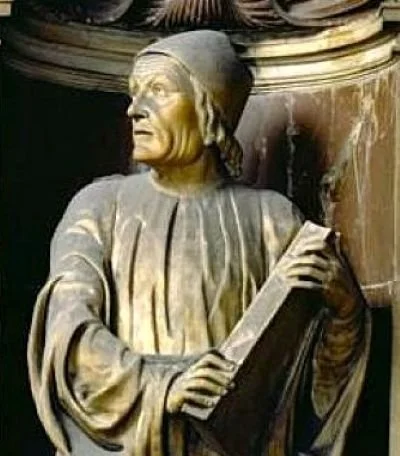
Fig.3 Marsilio Ficino (Andrea Ferrucci,
duomo Firenze)
Marsilio’s nalatenschap:
Ondanks verscheidene (ongefundeerde) beschuldigingen van magie en ketterij die tegen hem geuit zijn, maar nooit tot een veroordeling geleid hebben, is zijn vertalingswerk en zijn filosofisch gedachtengoed een bron van kennis en inspiratie voor latere generaties gebleven. De figuur van Marsilio Ficino zal echter ook altijd gelinkt blijven aan het begrip “platonische liefde”, dat nog steeds voor verschillende interpretaties vatbaar blijft en veel te snel een smalende reactie ontlokt.
Hij is in Firenze gestorven op 1 oktober 1499 en werd bijgezet in de kathedraal. Blijkbaar heeft men er ook geen probleem mee gehad om Ficino daar een eerbetoon te geven. Hij heeft er een grafmonument gekregen dat dateert uit 1522 (toen de Medici reeds lang terug aan de macht waren) en dat gemaakt werd door Andrea Ferrucci (zie fig.3). Marsilio is er afgebeeld als kanunnik en heeft een boek in de hand met zijn filosofische geschriften en kijkt naar de koepel (6).
Zijn intellectuele nalatenschap (de bibliotheek van Careggi) heeft hij nagelaten aan zijn neef Ficino Ficini, de zoon van zijn jongere broer de apotheker Cherubino, die hem in zijn laatste dagen bijgestaan heeft. Marsilio had nog 2 andere broers, Daniele die ook apotheker was en de jurist Arcangelo, die in notariële akten vermeld werden naar aanleiding van de erfenis van hun vader Diotifeci (ca. 1478). Marsilio’s broers waren van oordeel dat zijn deel van de erfenis (bestaande uit huizen en landgoederen) verhoudingsgewijs te groot was omdat hij als kanunnik ook meer dan voldoende inkomsten had. In een notarieel document was er geen plaats voor filosofische overpeinzingen en van broederliefde (of enige andere vorm van liefde) was er blijkbaar geen sprake…
1. Volgens sommige bronnen zou hij eind jaren 50 ook geneeskunde (zoals zijn vader) zijn gaan studeren (in Bologna of in Firenze?), maar daar bestaat twijfel over. Hij had in ieder geval een grote interesse voor de artsenijkunde.
2. Ficino is ooit beschuldigd geworden van necromancie (het oproepen van de doden om voorspellingen te doen) maar dat soort van demonische magie werd door de neoplatonisten afgewezen.
3. In principe was de platonische liefde niet seksueel, maar van vele intellectuelen en kunstenaars uit de renaissance wordt toch gezegd dat zij homo-of biseksueel waren en misschien was dat in vele gevallen ten onrechte.
4. Van de Lente (of La Primavera), een werk dat Botticelli geschilderd had voor de bruiloft van Lorenzo il Popolano, wordt gezegd dat Ficino mee het thema en de uitvoering bepaald had.
5. Er zijn auteurs die beweren dat Ficino connecties zou gehad hebben met de complotteurs die betrokken waren bij de Pazzi-aanslag van 1478. Die ongefundeerde verdachtmaking is alleen maar gebaseerd op de satirische geschriften van de dichter Luigi Pulci die het niet goed kon vinden met Marsilio en hem graag in een slecht daglicht plaatste. Het is niet omdat hij in 1451 aan huis kwam bij Piero de’ Pazzi (die al in 1464 overleden was) dat hij 27 jaar later zou gesympathiseerd hebben met de aanslag tegen de Medici-broers.
Ficino zou in 1494 ook te maken gehad hebben met de moord op Pico della Mirandola met wie hij nogal eens van mening durfde te verschillen. Maar daar zijn helemaal geen bewijzen voor en het lijkt ook weinig waarschijnlijk.
6. Ficino kijkt naar de Zon (het zichtbare beeld van God), die haar stralen door de koepel stuurt via het gnomon-gaatje dat Paolo Toscanelli in de lantaarn had laten aanbrengen in 1475.
JVL
Marsilio Ficino, Renaissance philosopher, magician or heretic (1433-99)?
Marsilio, uomo universale:
The humanist, priest, philosopher, astrologer, writer, musician and physician Marsilio Ficino was born on October 19th 1433 in Figline Valdarno. His parents were Diotifeci d'Agnolo di Giusto Ficini and Alessandra di Nanoccio di Montevarchi. Diotifeci was the personal physician of Cosimo de' Medici and when Marsilio had completed his classical training in the artes liberales (the liberal arts), and after studying in Pisa for 2 years, he became a student at the Studio, the Florentine University, in 1451. There he was taught philosophy by Niccolò Tognosi da Foligno and he developed a great interest in Greek philosophers, especially Plato.
After having already written several works on philosophy in Latin, he was advised by Cosimo de' Medici (ca. 1460) to attend the lectures in Greek by Joannes Agyropoulos, the Byzantine scholar who had come to Florence on the occasion of the Ecumenical Council of 1439 (1).
Marsilio and the Neoplatonic Accademia:
Marsilio Ficino is best known as the leader of the Neoplatonic Academy that Cosimo il Vecchio founded in 1462. The Medici banker provided the books and manuscripts that Ficino needed and he let him stay in a house near the Medici Villa in Careggi. Together with the other members Cristoforo Landino and Agnolo Poliziano, he is depicted in a fresco by Ghirlandaio in the Capella Tornabuoni (see fig.1).
The Accademia was intended to study the philosophy of Neoplatonism, which had given a new impetus to Plato's ideas. Neoplatonism exerted great influence on Christian theology in late antiquity and the Middle Ages, mainly through the work of Saint Augustine of Hippo, who was influenced by the early Neoplatonists Plotinus and Porphyry. The Florentine Neoplatonists considered themselves "true" Platonists and therefore called their group the Accademia Platonica.
Marsilio and his philosophical ideas:
Ficino's philosophy was based on 3 main pillars: Neoplatonism, Hermeticism and Christianity. He is best known as a follower of Plotinus (whose work he translated entirely from Greek into Latin) who had adopted the dualism between Plato’s supernatural and inferior visible world.
1) For the Neoplatonist, reality consists of 3 layers or levels: at the top is "the One", i.e. the cause of all that exists (Plato's "Idea of the Good"), in the middle is the level of "the Spirit" (the Nous) with Plato's “Ideas” and at the bottom there is "the Soul" (the immortal soul that has seen the Ideas before birth) that can take us to levels 2 and 1. Ficino wrote about this in his De Vita Libri Tres (1480-89), a copy of which, dedicated to Lorenzo il Magnifico, is preserved in the Biblioteca Laurenziana (see fig.2).
2) Hermeticism or Hermeticism is a Hellenistic religion from late antiquity, which aims to initiate man into the hidden reality that is in and behind the visible reality, in order to arrive at an intuitive knowledge of God and a personal, direct experience of God through knowledge of oneself and the universe. Most of the writings from the Hermetics are attributed to the mythical teacher Hermes Trismegistus.
Hermeticism attached great importance to the astral influences on human existence (the position of the celestial bodies), so that Ficino ended up in the field of astrology, the importance of which he already recognized as a physician. With his interest in hermeticism, alchemy and astrology, he also made an important contribution to the development of Western esotericism (philosophical movements intended only for a limited group of initiates) in the 15th century.
3) He saw similarities between the Gospel and the Corpus Hermeticum (which he had fully translated and called the "real" Bible) in his attempt to return to the roots of Christianity. According to him, Christianity was based on other, older religions such as Egyptian, Persian and Jewish.
The existence of a soul made a clear link to Christianity, so that in Ficino's case one can speak of a Christianized Platonism. He was of the opinion that neither Platonism nor other spiritual movements and religions necessarily had to be in conflict with Christianity (after all, he was also a priest), so that one could also call him a theosophist (someone who assumes that every religion has a part of the truth in it). Ficino made this view clear in his work La Religione Cristiana from 1476, written in Italian.
In Dante's Divina Commedia (1308-21) there was already talk of a worldview in which love and the human soul are central and in which the aim must be to climb from the earthly to the heavenly level. Dante was also inspired by the views of the astrologers, but he rejected their determinism, because man still has his free will.
Marsilio and astrology:
Because of his "suspicious theories" about the link between Christianity and astrology, Ficino had been accused of magic (sorcery) by Pope Innocent VIII in 1489, but these accusations had been set aside by Lorenzo de' Medici (2). Planets can influence the human body and character and certain plants and even stones have specific powers and music, smells and colours can affect the human soul. That music softens the morals and sunshine makes people happy are old wisdoms.
Ficino can be called a "magician", but a natural magician, someone who tries to understand and exploit the secrets of nature.
He was good friends with the sons of Pierfrancesco de' Medici. In 1478, he had written to the then 15-year-old Lorenzo (later il Popolano) that "in arranging his Luna (i.e., the interaction between body and mind), he should avoid too many (bad) influences from Mars and Saturn and acquire the beneficial influences of Sol (Sun), Jupiter and Venus". In Christian language, one could speak of seeking a balance between the earthly and the divine.
Marsilio and earthly and divine love:
For Ficino, earthly love was the love of physical beauty, the attraction between people and the connection through senses and emotions. Divine love was the love of the soul and the spirit and ultimately the love
of God. Earthly love could therefore be a starting point, but the ultimate goal was divine love. In his De Amore o Commentarium in Convivium Platonis (from 1469) he describes how platonic love can lead the soul upwards from physical beauty to the contemplation of God. This work was dedicated to Giovanni Cavalcanti, a young poet and member of the Accademia who lived with him in Careggi and with whom, according to the slanderers, he had a homosexual relationship. It is very likely that this was a Platonic love in the real spiritual sense of the word (and which could therefore also exist between men) because in his De Amore he condemned sodomy (3).
Marsilio and art:
Michelangelo is known to have attended the meetings of the Accademia and to have been a convinced Neoplatonist. Man can reach the highest level through 3 virtues, faith, love and beauty. The latter in particular was a goal for Michelangelo and in his artistic expressions he was always looking for the perfect ideal of beauty. In addition to the outer (physical) beauty, there is the beauty that transcends the physical and that comes from the soul of man. But that soul is, as it were, trapped in the human body and Michelangelo illustrates this, for example, in his sculptures of the Slaves (from the Galleria dell' Accademia in Florence) in which they want to free themselves (and also their souls) from the marble.
Michelangelo had also problems with an inner struggle between love and desire: in his sonnets for Tommaso Cavalieri and Vittoria Colonna, platonic love (for both a man and a woman) came to expression.
Ficino's ideas also seem to have influenced Leonardo da Vinci: in his famous Last Supper he is said to have placed Christ (as a kind of sun) in the middle and the apostles are divided into 4 groups of 3, referring to the elements of the Zodiac.
Sandro Botticelli was also closely associated with the ideas of the Accademia. While in his Madonnas divine love is strongly present, in his Primavera and Minerva with the Centaur earthly love and the restraint of lust are the main object (4).
Marsilio and Savonarola:
Marsilio had been ordained a priest in 1473 and appointed canon of the chapter of the Florentine cathedral but he was also convinced that the Catholic Church was in dire need of reforms. Initially, therefore, he was sympathetic to the reform ideas of Girolamo Savonarola (who had been elected prior of San Marco in 1482), but when the penitential preacher became more and more extreme and irreconcilable, it came to a break.
Savonarola felt that Ficino placed too little emphasis on sin, repentance, and divine grace, considered Neoplatonism "pagan," and rejected any connection to astrology, medicine, chemistry, or music. The penitential preacher wanted a quick and radical approach to the necessary abuses, while Marsilio was more in favour of a philosophical and gradual evolution without coercion. Ficino had already warned in the early 90s (so before Savonarola had become not only the spiritual, but also the political leader of Florence in November 1494) about the growing intolerance of the frate. In 1495 Marsilio had published in Venice a compilation of all his letters, the Epistolae, which he had written to Piero and Giovanni de' Medici (the sons of il Magnifico) and to his friends Giovanni Pico della Mirandola and Agnolo Poliziano during the past few years, warning against the radical puritanism of Savonarola without, however, mentioning him by name.
Ficino was clearly afraid of possible repressive measures by the frate and he also had his famous Apologia contre Savonarolam published in 1498, shortly after his death.
With the death of Lorenzo il Magnifico in 1492, the success of the Neoplatonic Academy had also come to an end: 2 eminent members, Agnolo Poliziano and Giovanni Pico della Mirandola, died in 1494 under suspicious circumstances (poisoning?) and when in the same year Girolamo Savonarola had gained power in Florence, and was able to carry out his religious purification, the ideas of Neoplatonism were put aside. Marsilio Ficino retreated to Careggi (then outside Florence), where he lived until his death.
Marsilio and politics:
While Savonarola wanted to put an end to the Medici regime, Ficino can be described as a close friend of the banking family that had ruled Florence since 1434 (5). He kept in touch with Piero lo Sfortunato while the latter was in exile, but as far as is known, Ficino was not actively involved in the attempts to restore him to power. However, Marsilio was very shocked when Savonarola did not oppose the execution of Bernardo del Nero and his 4 co-conspirators, who were accused of Medici sympathies in August 1497.
On the political level, Ficino was a proponent of a harmoniously structured society, where everyone knows his place and which is led by a wise ruler with moral principles and is therefore not necessarily democratic. Ficino's ideas were successful in Medici times, but in 1494 this came to an end. He never had any political ambitions. A clergyman could not hold a political mandate, but he could have a great influence on the government (as did Savonarola).
Marsilio’s legacy:
Despite several (unsubstantiated) accusations of magic and heresy that have been made against him, but have never led to a conviction, his translations and his philosophical ideas have remained a source of knowledge and inspiration for later generations. However, Marsilio Ficino will always be linked to the concept of "platonic love", which still remains open to different interpretations and elicits a scornful reaction far too quickly.
He died in Florence on October 1st 1499 and was buried in the cathedral. Apparently the Church had no problem giving Ficino a tribute there. He has been given a funerary monument that dates from 1522 (when the Medici had long since returned to power) and that was made by Andrea Ferrucci (see fig.3). Marsilio is depicted as a canon and has a book in his hand with his philosophical writings and looks at the dome (6).
He left his intellectual legacy (the library of Careggi) to his nephew Ficino Ficini, the son of his younger brother the pharmacist Cherubino, who assisted him in his last days. Marsilio had 2 other brothers, Daniele who was also a pharmacist and the lawyer Arcangelo, both mentioned in notarial deeds regarding the inheritance of their father Diotifeci (ca. 1478). Marsilio's brothers were convinced that his share of the inheritance (consisting of houses and estates) was proportionately too large because he had more than enough income as a canon. In a notarial document there was no room for philosophical musings and there was apparently no question of brotherly love (or any other form of love) either….
1. According to some sources, he would also have studied medicine (like his father) in the late 50s (in Bologna or in Florence?), but that is not confirmed. In any case, he had a great interest in medicine.
2. Ficino was once accused of necromancy (summoning the dead to make predictions) but that kind of demonic magic was rejected by the Neoplatonists.
3. In principle, Platonic love was not sexual, but many intellectuals and artists of the Renaissance are said to be homosexual or bisexual, and perhaps in many cases this was false.
4. It is said that Ficino helped determine the theme and the execution of Botticelli’s “Spring” (or La Primavera), a work that was painted for the wedding of Lorenzo il Popolano.
5. Some authors claim that Ficino would have had connections with the conspirators involved in the Pazzi attack of 1478. This unfounded suspicion is only based on the satirical writings of the poet Luigi Pulci, who did not get along well with Marsilio and liked to put him in a bad light. It is not because he came to Piero de' Pazzi's house in 1451 (who had already died in 1464) that Ficino would have sympathized with the Pazzi attack on the Medici brothers 27 years later.
It is also said that he was implicated in the murder of Pico della Mirandola in 1494, with whom he often disagreed. But there is no evidence for this at all and it seems very unlikely.
6. Ficino is looking at the Sun (the visible image of God), which sends its rays into the dome through the gnomon hole that Paolo Toscanelli had placed in the lantern in 1475.
Literatuur:
De Pazzis, H & E. Savonarole. Parijs,1998.
Farinelli, S. Marsilio Ficino e l'Accademia neoplatonica di Firenze | Meer
Felici, L. Ficini, Ficino. In: Dizionario biografico, vol.47 (1997).
Fubini, R. Firenze e i Medici all’avvento di Lorenzo il Magnifico.
(Rinascimento, nr.24, 1984).
Garin, E. Ritratto di Marsilio Ficino (JSTOR vol.6 nr3 1951).
Margolis, O e.a. The ‘schemes’ of Piero de’ Pazzi and the conflict with the Medici
(1461-62). In : Journal of Medieval History vol 41, 2015.
Marietti, M. Savonarole. Parijs, 1997.
Signoriello, F. Satire of Philosophy and Philosophers in Fifteenth Century
Florence (PhD thesis, University of London, 2013).
Van Laerhoven, J. Florentijnse wandelingen, dl. IX (Marsilio Ficino). Herk-de-Stad, 2017.
zie art. Sandro Botticelli en de Lente.
zie art. Girolamo Savonarola, visionair of valse profeet?
zie art. Was Giovanni Pico della Mirandola het slachtoffer van
syfilis of moord?
Vasoli, C. Ficino, Marsilio. In: Dizionario biografico, vol.47 (1997).