Wie is de Mona Lisa van Leonardo?
Wie is de Mona Lisa van Leonardo?
Volgens de meeste kunsthistorici is de Mona Lisa (of La Gioconda) van Leonardo da Vinci te vereenzelvigen met Lisa Gherardini, de echtgenote van de Florentijnse zijdekoopman Francesco del Giocondo (zie art. Bronnen die “bewijzen” dat Lisa del Giocondo Leonardo’s Mona Lisa is).
Niet iedereen is daar echter van overtuigd en er zijn de laatste jaren heel wat personages naar voor geschoven om haar plaats in te nemen. Die zijn soms wat ver gezocht, maar soms ook verrassend en interessant kunnen zijn. Hier volgt een overzicht.

Fig.1 Madonna mer het Kind en Sint-Anna (Louvre)
1. l’ Uomo ideale:
Misschien is Mona Lisa simpelweg Leonardo’s ideaal type van mens en een schoonheidsideaal, dat een synthese moest zijn van alle personen, mannen en vrouwen, die hem lief waren. Wie het werk van da Vinci kent kan vaststellen dat zijn Mona Lisa-type geregeld terugkeert als vrouwelijk personage in een aantal andere schilderijen. Zo is er een gelijkenis te vinden met o.a. het onafgewerkte karton met de Heilige Anna (National Gallery) uit 1498 en de Sint-Anna ten Drieën (Louvre) uit 1510 (zie fig.1). Hetzelfde type vrouw verschijnt wellicht ook al op de Madonna van de Rotsen (versie Louvre 1483-86 en versie National Gallery 1491-1508).
De androgyne figuren van da Vinci vertonen zowel vrouwelijke als mannelijke trekken; men denke hierbij aan de figuur van Johannes de Doper (zie verder) en de figuur van Johannes de Apostel op zijn beroemde Laatste Avondmaal (zie art. Wie is wie in Leonardo’s Laatste Avondmaal).
De theorie van het geïdealiseerd fictief personage is zeer aannemelijk want ook bij andere kunstenaars, zoals bijvoorbeeld Sandro Botticelli, keert dezelfde figuur steeds terug in vele werken. Maar net zoals bij Botticelli is het niet uitgesloten dat het personage toch gebaseerd was op een bestaand iemand (zie art.Botticelli en de ideale vrouw).
2. Leonardo’s moeder:
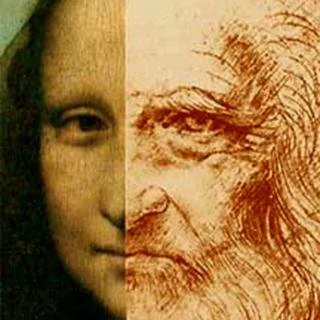
Fig.2 Fotomontage L. Schwartz (Mona Lisa = Leonardo)
Leonardo was het onwettige kind van notaris ser Piero d’ Antonio da Vinci en een zekere Caterina Lippi, een weesmeisje uit de omgeving dat achteraf werd uitgehuwelijkt aan een plaatselijke boer Antonio Butti. De knaap werd echter door zijn vader, toen die trouwde met Albiera Amadori, opgenomen in het gezin (zie art Piero en Caterina de ouders van het genie uit Vinci). Dat hij zijn moeder schilderde wordt o.a. naar voor geschoven door Serge Bramly.
3. Leonardo zelf:
Omwille van de gelijkenis met een later zelfportret (uit de Biblioteek van Turijn) zou men in de figuur van Mona Lisa de gelaatstrekken van Leonardo zelf kunnen herkennen (zie fig.2). Het blijft altijd mogelijk dat de kunstenaar (die homoseksueel of biseksueel was) zijn vrouwelijke kant heeft willen vastleggen. Deze visie sluit ook aan bij de bewering dat de Mona Lisa een portret van zijn moeder zou kunnen zijn.
4. Andrea Salai (Gian Giacomo Caprotti di Oreno):
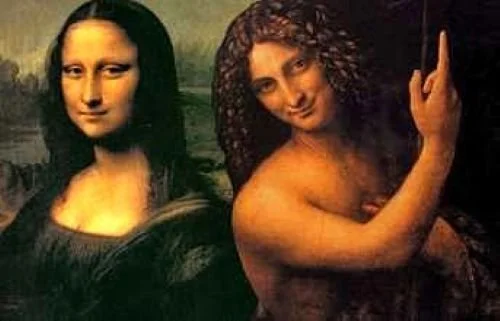
Fig.3 Mona Lisa = Salai (Louvre)
Er is ook een zeer sterke gelijkenis merkbaar tussen de Mona Lisa en de figuur van Sint-Jan de Doper (1513-16) uit het Louvre waarvan men veronderstelt dat zijn leerling (en minnaar?) Andrea Salai er model voor gestaan heeft (zie fig.3). Salai was reeds van zijn 10 jaar in het atelier van Leonardo en is 30 jaar lang zijn metgezel gebleven.
Het schilderij met de Sint-Johannes bevond zich volgens Antonio de Beatis, (de secretaris van kardinaal Louis van Aragon, die Leonardo in 1517 in Frankrijk bezocht had) samen met het portret van een Florentijnse dame en de Sint-Anna ten Drieën in 1517 in de woning van Leonardo in Clos-Lucé, waar Salai met hem samenwoonde.
Op de oogleden van Mona Lisa zouden volgens Silvano Vinceti de letters L (Leonardo) en S (Salai) te vinden zijn, maar dat lijkt eerder wishful thinking.
Om te bewijzen dat Salai wel degelijk model gestaan heeft voor de Mona Lisa heeft Lilian Schwartz aangevoerd dat Mona Lisa een anagram is voor Mon Salai. Zij is dan wel vergeten dat Monna Lisa (afkorting van madonna Lisa) in het Italiaans met dubbele n geschreven wordt.
5. Pacifica Brandano, Isabella Gualanda of Costanza d’ Avalos:
Wanneer Antonio de Beatis sprak over het portret van een “zekere Florentijnse dame, die in vivo geschilderd was op verzoek van wijlen Giuliano de’ Medici” zou daarmee volgens sommige auteurs (zoals Roberto Zapperi) één van de minnaressen van Giuliano, de jongste zoon van il Magnifico en hertog van Nemours, bedoeld zijn. Dat zouden dan Pacifica Bradano, Isabella Gualanda of Costanza d’Avalos kunnen zijn. Giuliano zou van Pacifica een portret hebben laten maken in 1511 toen zij kort na de geboorte van hun zoontje Ippolito gestorven is (zie art. De mysterieuze dood van Ippolito de’ Medici) . Giuliano is zelf overleden in 1516 vooraleer het portret voltooid was. Er was dus geen koper meer en misschien heeft Leonardo (volgens Zapperi) het portret meegenomen en getransformeerd tot de Mona Lisa zoals we ze nu kennen.
Pacifica was afkomstig uit Urbino, zodat het weinig waarschijnlijk is dat zij de “Florentijnse dame” was. Dat het Isabella Gualanda uit Napels zou zijn, die de Beatis in zijn dagboek wel vermeldt, maar niet uitdrukkelijk als de minnares van Giuliano, is ook twijfelachtig en volges Fiorenzo Laurelli Costanza d’Avalos, de hertogin van Francavilla en Giuliano enkel bevriend. Van deze 3 dames is verder ook geen betrouwbaar portret bekend.
Sommige auteurs (zoals Serge Bramly) denken dat Mona Lisa Giuliano’s echtgenote Filiberta van Savoy zou kunnen zijn, maar als de Mona Lisa dateert uit 1503 (of daar omtrent) is dat chronologisch gezien onmogelijk want Filiberta is geboren in 1498. Zelfs als het schilderij pas in 1515 geschilderd werd, toen zij getrouwd is met Giuliano, kan zij moeilijk van de vrouw van in de 30 geweest zijn van het portret. Bovendien was Filberta geen Florentijnse dame maar een Franse prinses.
Het is echter niet uitgesloten dat Giuliano, toen Leonardo in 1513 in zijn dienst was getreden in Rome, een portret heeft laten maken van Lisa del Giocondo, die hij nog kende van in zijn jeugd (zie art. Lisa Gherardini, Francesco del Giocondo en Giuliano de’ Medici). Op die manier zou het dan toch een schilderij van een Florentijnse dame kunnen geweest zijn, van wie de kunstenaar de identiteit blijkbaar niet aan De Beatis had kenbaar gemaakt.
6. Fioretta Gorini:
Volgens Angelo Paratico zou de mysterieuze Florentijnse dame Fioretta Gorini geweest zijn, de minnares van de andere Giuliano de’ Medici, de broer van Lorenzo il Magnifico, die in april 1478 tijdens de Pazzi-aanslag is vermoord geworden. Leonardo zou het tijdens het gesprek met de kardinaal van Aragon en Antonio de Beatis dus niet over wijlen Giuliano, hertog van Nemours, gehad hebben, maar over diens overleden oom met dezelfde naam. Die zou dan opdracht gegeven hebben aan de jonge Leonardo om in 1477/78 Fioretta’s portret te schilderen toen zij in verwachting was. Kort na de geboorte van haar zoontje Giulio (de later paus Clemens VII) is zij echter in datzelfde 1478 overleden. Aangezien opdrachtgever en geportretteerde dood waren heeft Leonardo het schilderij dan maar bij zich gehouden.
Het portret moet dan, in tegenstelling met wat algemeen gedacht wordt, niet in 1503, maar al 25 jaar eerder geschilderd zijn en dat roept twijfels op.
Paratico merkt nog op dat Leonardo voor de Mona Lisa populierenhout gebruikte en pas in zijn Milanese periode naar notelaar is overgeschakeld, maar dat is een weinig doorslaggevend argument. Dat hij toen echter al in staat was om een dergelijk werk te penselen had Leonardo bewezen met het portret van Ginevra de’ Benci (uit de National Gallery) dat hij rond dezelfde tijd geschilderd had en waarvan door Maike Vogt gezegd wordt dat het ook Fioretta zou zijn.
Fioretta was 24 jaar en de dame op het portret van Mona Lisa is ouder. Volgens Paratico is het portret achteraf getransformeerd tot de huidige Mona Lisa, die echter niet Lisa del Giocondo is.
Vooral omwille van de manke chronologie en ook vanuit stilistisch en technisch oogpunt is deze Fioretta-theorie niet erg overtuigend.
7. Lisa di Bartolommeo del Giocondo:
Aangezien Vasari nergens uitdrukkelijk de naam Lisa Gherardini vermeldt, maar enkel spreekt over Lisa de vrouw van Francesco del Giocondo, beweert Giuseppe Pallanti dat het gaat over de zus van Francesco, die dus ook del Giocondo heette en niet Gherardini. Zij was (ca.1487) getrouwd met haar achterneef, ook een Francesco (of Pierfrancesco) del Giocondo en ook een zijdehandelaar.
Stamboom del Giocondo
Giovangualberto
____________|____________
| |
Zanobi ?
| |
Bartolommeo Pierfrancesco
______|______________ |
| | |
Francesco Lisa x Francesco
(1465-1539) (°1468)
x Lisa dei Gherardini
Enerzijds valt er voor deze theorie wel wat te zeggen, want in de renaissance was het gebruikelijk dat vrouwen hun eigen familienaam behielden, maar anderzijds zou deze Lisa (geboren in 1468) in 1503 al 35 en in 1517 al 49 jaar geweest zijn en is het dus niet zeker dat zij de dame van het portret geweest kan zijn op basis van haar leeftijd.
In zijn aantekening van oktober 1503 op een werk met “Brieven van Cicero” uit de universiteitsbibliotheek van Heidelberg (zie art. Bronnen die “bewijzen” dat Lisa del Giocondo Leonardo’s Mona Lisa is) spreekt Agostino Vespucci over een schilderij dat Leonardo gemaakt had van Lise del Giocondo en niet van Lise Gherardini…Lisa di Bartolommeo kan echter wel de Florentijnse dame van de Beatis zijn..
8. Cecilia Gallerani en Lucrezia Crivelli:

Fig. 4 Cecilia Gallerani & Lucrezia Crivelli
Het portret van Cecilia Gallerani is ook bekend als de Dame met de Hermelijn en is bewaard in het Museum van Krakau en het portret van Lucrezia Crivelli uit het Louvre (zie fig.4) wordt daar ook La Belle Ferronnière genoemd. Er is misschien wel enige gelijkenis te bespeuren met de Mona Lisa, maar beide dames worden echter (door Pedretti en Zöllner) geïdentificeerd als minnaressen van hertog Ludovico Sforza en zijn door Leonardo tijdens zijn Milanese periode geportretteerd (tussen 1489 en 1496).
La Belle Ferronnière is (volgens Sylvie Béghin) misschien ook een portret van Beatrice d’Este, de echtgenote van Sforza en als de moeilijk te herkennen letters op het ooglid van Mona Lisa niet S en L maar B en L zouden zijn, zou zij volgens Silvano Vinceti ook deze Beatrice d’Este kunnen zijn. Maar dat zijn nogal veel “alsen” en Beatrice was reeds in 1497 overleden.
9. Caterina Sforza:
Ook van Caterina Sforza, de gravin van Forli, wordt door Magdalena Nabb en Carla Glori gezegd dat zij de Mona Lisa zou zijn. Haar portret als la dama dei Gelsomini wordt toegeschreven aan Lorenzo di Credi en het dateert uit 1481/82. Er is eventueel een gelijkenis met Mona Lisa waar te nemen, maar Caterina was geen Florentijnse en in 1503 al 40 jaar (zie art. Caterina Sforza, de tijgerin van Forli).
10. Isabella d’ Este:

Fig. 5 Isabella d’ Este – Mona Lisa (Louvre)
Carlo Pedretti is van oordeel dat de Mona Lisa een portret is van Isabella d’Este, de vrouw van Francesco II Gonzaga en de zus van Beatrice. Toen Leonardo in 1499 in Mantua vertoefde vroeg markiezin Isabella hem om haar portret te maken. In het Louvre is de voorbereidende tekening bewaard (zie fig.5), waarvan men overtuigd is dat ze van de hand van Leonardo is en die sterke overeenkomsten vertoont met het portret van Mona Lisa (pose, kin, handen en haar).
In 1501 had Isabella in een brief aan Leonardo gevraagd om haar ritratto (deze tekening) om te zetten in een geschilderd portret. Maar dat is blijkbaar niet gebeurd aangezien zij daarna andere kunstenaars ingeschakeld heeft. Misschien heeft Leonardo het portret achteraf dan toch afgemaakt, maar is het nooit afgeleverd en heeft hij het bij zich gehouden.
Pedretti argumenteert dat Vasari, die in 1550 schreef dat Leonardo werkte aan een portret van de vrouw van Francesco del Giocondo, geen ooggetuige was en 2 schilderijen verward heeft (wat ook kan blijken uit zijn beschrijving). Pedretti ontkent niet dat Leonardo een portret van Lisa aan het schilderen was, maar identificeert dat niet met de Mona Lisa uit het Louvre. Dezelfde redenering geldt ook in verband met de Vespucci-nota uit 1503.
10. Isabella van Napels van Aragon:
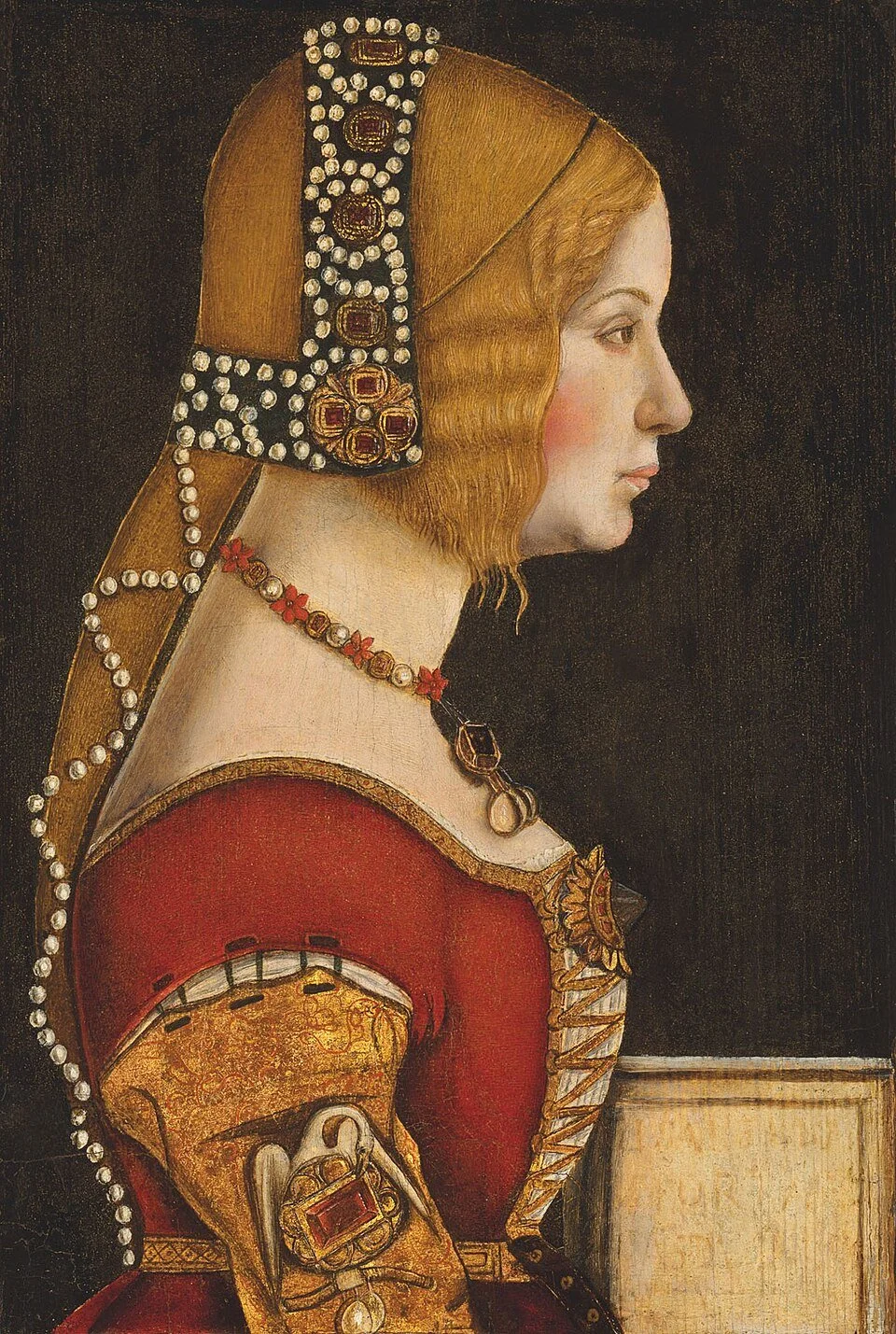
Fig. 6 Isabella van Napels of Aragon (Bernardino de’ Conti, privé-collectie).
Dat de dame op het portret uit het Louvre Isabella van Aragon (1470-1524), de echtgenote van Galeazzo Sforza hertog van Milaan, zou zijn is de mening van Maike Vogt-Luerssen , die daarmee de zienswijze van Robert Payne volgt. Het schilderij moet dan echter gemaakt zijn in 1489 toen Isabella 19 jaar was, zodat de hele bestaande klassieke datering van de Mona Lisa op de helling komt te staan.. Vogt argumenteert dat de ineengestrengelde ringen op het kleed verwijzen naar de Sforza. De geportretteerde dame draagt een donkergroen kleed dat typisch was voor de laatste maanden van een rouwperiode; Isabella’s moeder Ippolita Sforza was overleden op 19 augustus 1488. De Mona Lisa (Isabella dus) uit het Louvre zou dan kunnen dateren van midden 1489 (zie art. Was Leonardo getrouwd met Isabella van Aragon?).
De aanhangers van de Isabella-Mona Lisa baseren zich ook op de gelijkenis met andere vermeende schilderijen van Isabella, zoals portretten door Bernardo Luini en Rafael Sanzi. Maar het voorlopig als het meest betrouwbare portret van Isabella werd geschilderd door Bernardino de’ Conti (uit de Milanese school) ca. 1495-1500 en vertoont toch weinig faciale overeenkomsten met de Mona Lisa (zie fig.6).
Maike Vogt is ook geneigd om Isabella te herkennen in het portret van Leonardo’s Belle Ferronière (zie fig.4)
Indien Isabella inderdaad de Mona Lisa zou zijn, kan men zich afvragen waarom kardinaal Luigi van Aragon, die (zo bericht de Beatis) het schilderij van de Florentijnse dame in 1519 gezien had in Amboise (en waarvan men denkt dat het de Mona Lisa uit het Louvre is) zijn nicht Isabella niet zou herkend hebben. Maar misschien wilde hij dat niet en heeft hij haar identiteit niet bekend gemaakt aan zijn secretaris. Isabella was trouwens ook geen Florentijnse dame waarover Leonardo gesproken had.
Besluit:
Er zijn dus theorieën genoeg in verband met de identiteit van de Mona Lisa of la Gioconda, waarvan de ene al geloofwaardiger is dan de andere. Indien men een antwoord kan vinden op de vraag waarom da Vinci het portret steeds bij zich had en waarom hij het steeds aangepast heeft zou men al heel wat dichter bij een identificatie staan.
Enerzijds zou men er kunnen vanuit gaan dat er een emotionele band moet geweest zijn met de dame in kwestie, die hij vanop afstand bewonderde en op haar levenspad volgde van teenager tot rijpere vrouw.
Anderzijds zou het ook kunnen dat Leonardo dit portret (van een imaginaire of geïdealiseerde figuur) beschouwde als een proefproject voor zijn experimenten als schilder en het dientengevolge dan ook regelmatig ging aanpassen en het steeds bij zich hield.
Of misschien is hij het portret begonnen op bestelling, maar omdat het nooit afgehaald werd is het dan geëvolueerd tot het test-schilderij waarvan sprake.
Het is wachten op nieuwe bevindingen die de exacte waarheid kunnen onthullen en de raadsels omtrent deze mysterieuze dame eindelijk zullen oplossen.
JVL
Who is Leonardo’s Mona Lisa?
According to most art historians Leonardo da Vinci’s Mona Lisa (or la Gioconda) can be identified with Lisa dei Gherardini, the wife of the Florentine silk merchant Francesco del Giocondo (see art. Sources that “prove” that Lisa del Giocondo is Leonardo’s Mona Lisa). However not everyone is convinced of this and over the years many characters have been put forward to take her place in the portrait, sometimes a bit far-fetched, but sometimes also surprising and interesting. Here is an overview.
1. l’uomo ideale:
Perhaps Mona Lisa is Leonardo's ideal type of a human being, his ideal of beauty and a synthesis of all the men and women who were dear to him. Anyone who knows da Vinci's work can see that his Mona Lisa type regularly returns as a female character in a number of other paintings. For example, there is a similarity with the unfinished sketch of Saint Anne (National Gallery) from 1498 and the Virgin with Child and Saint Anne (Louvre) from 1510 (see fig.1). The same type of woman may also appear on the Madonna of the Rocks (version Louvre 1483-86 and version National Gallery 1491-1508).
Da Vinci's androgynous figures show both feminine and masculine traits; such as John the Baptist (see below) and John the Apostle on his famous Last Supper (see art. Who is who in Leonardo’s Last Supper?).
The theory of this ideal type (defended by Martin Kemp) is very plausible because in the works of many other Renaissance artists (such as Sandro Botticelli) the same figure recurs frequently. But as with Botticelli, it is not excluded that some characters are still based on a real person (see art. Sandro Botticelli and the portrait of the Ideal woman).
2. Leonardo's mother:
Leonardo was the illegitimate child of notary Ser Piero d'Antonio da Vinci and a certain Caterina Lippi, an orphan girl from the neighborhood who was later married off to a local farmer Antonio Butti. Young Leonardo was taken into the family by his father, when he married Albiera Amadori (see art. Piero and Caterina, the parents of the genius from Vinci). That he painted his mother is put forward by Serge Bramly.
3. Leonardo himself:
Because of the resemblance with the self-portrait (from the Library of Turin) one could recognize in the figure of Mona Lisa the facial features of Leonardo (see fig.2). It is always possible that the artist (who is said to be homosexual or bisexual ) wanted to externalize his feminine side. This theory is also in line with the idea that Mona Lisa could be a portrait of his mother.
4. Salai (Gian Giacomo Caprotti di Oreno):
There is also a very strong resemblance between the Mona Lisa and the Saint John the Baptist (1513-16) from the Louvre which is believed to be his pupil (and lover?) Salai (see fig.3). He entered Leonardo's studio when he was 10 and remained his companion for 30 years.
When Antonio de Beatis, (the secretary of Cardinal Louis of Aragon), visited Leonardo in France in 1517, he saw the painting of Saint John together with the portrait of a Florentine lady and the Virgin and Child with Saint Anne in Leonardo's home in Clos-Lucé, where Salai lived with him.
According to Silvano Vincenti, the letters L (Leonardo) and S (Salai) can be found on Mona Lisa's eyelids, but that seems more like wishful thinking (see below).
To prove that Salai was indeed a model for Mona Lisa, Lilian Schwartz claims that Mona Lisa is an anagram for Mon Salai. However, she seems to forget that Monna Lisa (short for Madonna Lisa) is actually written in Italian with double n.
5. Pacifica Brandano, Isabella Gualanda or Costanza d’ Avalos:
When Antonio de Beatis mentions the portrait of a "certain Florentine lady, painted in vivo on request of the late Giuliano de' Medici", he was (according to Roberto Zapperi) referring to one of the mistresses of Giuliano (the youngest son of Lorenzo il Magnifico). These ladies should then be Pacifica Bradano, Isabella Gualanda or Costanza d'Avalos.
Giuliano is said to have had a portrait made of Pacifica shortly after the birth of their son Ippolito and her death in 1511 (see art. The mysterious death of Ippolito de' Medici). Giuliano himself died in 1516 before the portrait was completed. So there was no client anymore and perhaps Leonardo took the painting with him (according to Zapperi) and transformed it afterwards into Mona Lisa as we know her today. Pacifica came from Urbino, so it is unlikely that she was the Florentine lady.
That it would be Isabella Gualanda from Naples, mentioned by De Beatis in his diary, but not explicitly as Giuliano's mistress, is very doubtful and that it would be Costanza d'Avalos, the Duchess of Francavilla, whom Giuliano apparently did not even know (according to Fiorenzo Laurelli), is particularly implausible.
There are no other portraits to be found of these 3 ladies.
Some critics (such as Serge Bramby) think that Mona Lisa could be Giuliano de’ Medici’s wife Filiberta of Savoy, but if the portrait dates from 1503 this is chronologically impossible because Filiberta was born in 1498. Even if the painting was made in 1515 (when she was married to Giuliano), she could hardly be Mona Lisa in her 30s. Moreover she was not a Florentine lady but a French princess.
It is however not excluded that Giuliano, when Leonardo had entered his service in Rome in 1513, had him painted a portrait of Lisa del Giocondo (the wife of Francesco) whom he knew from his youth (see art. Lisa Gherardini, Francesco del Giocondo and Giuliano de’ Medici). In that case she could then be the “Florentine lady”, whose identity Leonardo apparently had kept a secret from De Beatis.
6. Fioretta Gorini:
According to Angelo Paratico, the mysterious Florentine lady would have been Fioretta Gorini, the mistress of the other Giuliano de' Medici, the brother of Lorenzo il Magnifico, who was murdered in April 1478 during the Pazzi attack. So Leonardo was not referring to the late Giuliano the Duke of Nemours during his conversation with the Cardinal of Aragon and Andrea de Beatis, but to the duke’s deceased uncle with the same name.
Giuliano would then have commissioned the young Leonardo to paint Fioretta's portrait in 1477/78 when she was pregnant. She died shortly after the birth of her son Giulio (Pope Clement VII) and since the client and the sitter were dead, Leonardo kept the painting with him
So the portrait must not have been painted in 1503 as is generally assumed, but 25 years earlier and that raises doubts. Paratico notes that Leonardo was still using poplar wood at the time and only switched to walnut in his Milanese period, but that is not an decisive argument.
However, with the portrait of Ginevra de' Benci (from the National Gallery) which is also said (by Maike Vogt) to be a portrait of Fioretta, Leonardo had proven that he was more than capable to make already such a fine work in the 70s.
Fioretta was 24 years old at the time, but the lady in the portrait from the Louvre is older. Paratico claims that Leonardo transformed the portrait afterwards into the present Mona Lisa, who is not Lisa del Giocondo.
Mainly because of the chronological problems but also from a stylistic and technical point of view this Fioretta theory is not very convincing.
7. Lisa di Bartolommeo del Giocondo:
Since Vasari nowhere explicitly mentions the name Lisa Gherardini, but only speaks of Lisa del Giocondo, Giuseppe Pallanti argues that the sitter is Francesco del Giocondo’s sister, who was therefore also called del Giocondo and not Gherardini. She was married to her cousin, another Francesco (or Pierfrancesco) del Giocondo and also a silk merchant (see genealogy).
On the one hand there is something to be said for this theory, because in the Renaissance it was customary for women to keep their own family name, but on the other hand this Lisa (born in 1468) would have been 35 years old in 1503 and 49 in 1517 and it is therefore unlikely that she was the sitter of the portrait. However, Lisa di Bartolommeo del Giocondo may well be the “Florentine lady” of de Beatis.
8. Cecilia Gallerani and Lucrezia Crivelli:
The portrait of Cecilia Gallerani is also known as the Lady with the Ermine and is preserved in the Museum of Krakow and the portrait of Lucrezia Crivelli from the Louvre (see fig. 4) is also called La Belle Ferronnière. There may be some resemblance to the Mona Lisa, but these ladies are identified (by Pedretti and Zöllner) as mistresses of Duke Ludovico Sforza and were portrayed by Leonardo during his Milanese period (between 1489 and 1496).
La Belle Ferronnière may (according to Sylvie Béghin) also be a portrait of Beatrice d'Este, Sforza's wife. If the hard-to-recognize letters on Mona Lisa’s eyelid were not S an L but B and L, she could also be this Beatrice according to Silvano Vinceti. But that is quite a lot of “ifs” and Beatrice was already dead in 1497.
9. Caterina Sforza :
Caterina Sforza is also said (by Magdalena Nabb and Carla Glori) to be the Mona Lisa. Her well known portrait as La dama dei Gelsomini is attributed to Lorenzo di Credi, Leonardo’s pupil and dates from 1481/82 (see art. Caterina Sforza, the tigress of Forli). There may be a certain resemblance to Mona Lisa but Caterina was not a Florentine and in 1503 already 40 years of age.
10. Isabella d’Este:
Carlo Pedretti thinks that Mona Lisa is a portrait of Isabella d’ Este, the wife of Francesco II Gonzaga and the sister of Beatrice. When Leonardo was in Mantua in 1499, Isabella asked him to make her portrait. The preparatory drawing from the Louvre (see fig.5), which is believed to be by Leonardo, shows indeed some very strong similarities with the portrait of Mona Lisa (pose, chin, hands and hair).
In a letter of 1501 Isabella asked Leonardo to convert her ritratto (the drawing) into a painted portrait. But apparently that did not happen since she then engaged other artists. Leonardo may have finished the portrait later, but it was never delivered and he kept it with him.
Pedretti argues that Vasari, who wrote that Leonardo was working on a portrait of Francesco del Giocondo’s wife, was not an eyewitness and confused 2 paintings (which may also be evident from his description).
However Pedretti does not deny that Leonardo was painting a portrait of Lisa del Giocondo but does not identify her with Mona Lisa from the Louvre. He applies the same line of reasoning to the Vespucci note: while it confirms that Leonardo was painting a portrait of Lisa del Giocondo in 1503, it does not necessarily prove that the surviving Louvre painting is that portrait.
11. Isabella of Aragon/Naples:
That the lady in the portrait from the Louvre would be Isabella of Aragon or Naples (1470-1524), the wife of Galeazzo Sforza Duke of Milan, has been pointed out by Robert Payne and Maike Vogt-Lüerssen. The painting must then have been made in 1489 when Isabella was 19 years old, which disturbs the usual chronology.
Vogt argues that the intertwined rings on Lisa’s robe refer to the Sforza. The sitter is wearing a dark green dress that was typical of the last months of a mourning period: Isabella’s mother Ippolita Sforza had died on August 19, 1488. The Louvre portrait could then date from mid-1489 (see art. Was Leonardo married tot Isabella of Aragon?).
The supporters of the Isabella-Mona Lisa refer to resemblances to other alleged portraits of Isabella by Bernardo Luini and Raphael. But Isabella’s most reliable portrait by Bernardino de’ Conti (of the Milanese school) from 1495-1500 shows very few facial similarities with Mona Lisa (see fig.6).
Maike Vogt is also inclined to recognize Isabella in the portrait of Leonardo’s Belle Ferronnière (see fig.4).
But if Mona Lisa (from the Louvre) would indeed be Isabella of Aragon one might wonder why Cardinal Luigi of Aragon, who had seen the painting of the “Florentine lady” in 1519 in Amboise (as Antonio de Beatis reports), would not have recognized his niece Isabella. But maybe he did not want to expose her identity to his secretary. And by the way, Isabella of Naples was not a Florentine lady that Leonardo had spoken of.
Conclusion:
There are plenty of theories about the identity of the Mona Lisa or la Gioconda, one of which is already more credible than the other. If one can find an answer to the question why da Vinci always had the portrait with him and why he always adapted it, one would be much closer to an identification.
On the one hand one could assume that there must have been an emotional bond with the lady of the portrait, whom he admired from a distance and followed on her path of life from teenager to mature woman.
One the other hand, it could also be that Leonardo considered the portrait (of an imaginary or idealized person) as a test project for his experiments as a painter and consequently adapted it regularly and always kept it with him.
Or maybe he started the portrait for a client but because it was never delivered, it then evolved into the test painting in question.
In the meantime one has to wait for new findings that can reveal the exact truth and solve the riddles surrounding this mystery lady.
Literatuur :
Bramly, S. Leonardo : the Artist and the Man. Londen, 1994.
Burke, J. Agostino Vespucci’s Marginal Note about Leonardo da Vinci.
In: Leonardo da Vinci
Society Newsletter (mei 2008).
Cascone, S. Was the Mona Lisa based on Leonardo’s male lover?
In: Artnet News (April 2016)
Clark, K. Mona Lisa in: The Burlington Magazine (maart 1973).
Cotte, P. Mona Lisa dévoilée. Les vrais visages de la Joconde. Parijs, 2015.
Herford, S. Le Jocond. Neuilly-sur-Seine, 2011.
Isaacson, W. Leonardo da Vinci. De biografie. Houten, 2017.
Kemp, M. Leonardo da Vinci: the marvellous works of nature and man. Oxford, 2000.
Idem & Pallanti,G. The People and the Painting. Oxford, 2017.
Kraaijvanger, C. Verborgen letters in de ogen van Mona Lisa? In: Scientias (dec.2010).
Laurelli, F. La prima signora Elisa o della committenta del ritratto di Mona Lisa
Gherardini detto la gioconda, 2000. Monna Lisa Gherardini.doc
Pallanti, G. Mona Lisa Revealed. The True Identity of Leonardo’s Model. Milaan, 2006.
Paratico, A. A new hypothesis on Leonardo’s Mona Lisa. Was she Fiorette Gorini?
Gingko Edizioni, 2015.
Schwartz, L. The Computer Artists Handbook. New York, 1992.
Idem Morphing the Three Faces of Mona (Computers & Graphics, jg. 19 nr.4,1995).
Van Laerhoven, J. Leonardo & Michelangelo. Kermt, 2017.
zie art. Caterina Sforza, de tijgerin van Forli.
zie art. De glimlach van Mona Lisa
zie art. Lisa Gherardini, Francesco del Giocondo en Giuliano de’ Medici.
zie art. Was Leonardo getrouwd met Isabella van Aragon?
Vasari, G. The Lives of the Artists. Aylesbury, 1991.
Vecce, C. Leonardo. Rome, 1998.
Venturi, A. Storia dell ‘Arte Italiana IX. Milaan, 1925.
Vogt-Luerssen, M. Wer ist Mona Lisa? Norderstedt, 2003.
Idem Fioretta Gorini (and not Ginevra de Benci) – kleio.org